How To Pick The Best Solar Kits For Small Homes: 9 Things To Check Before You Buy
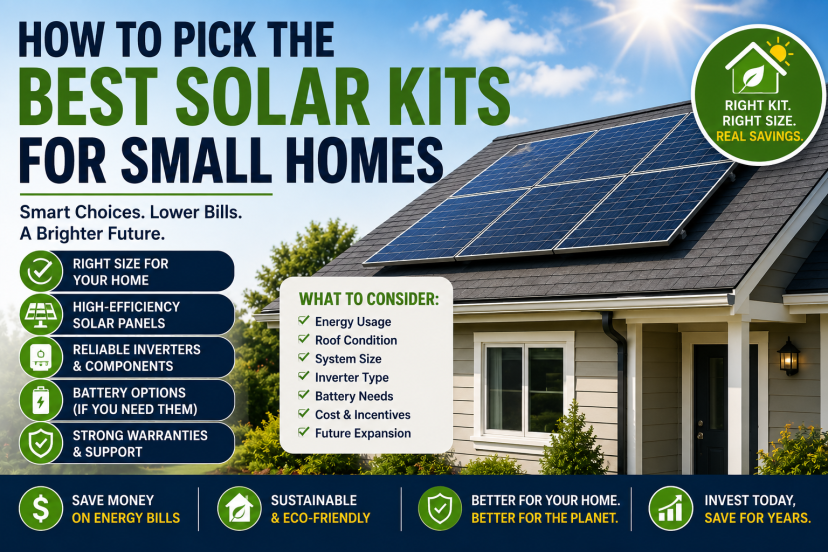
A small home doesn’t need a huge solar system to make a meaningful difference in monthly electricity costs. In fact, buying too much equipment can make solar unnecessarily expensive. The challenge is knowing exactly what you need. If you’re researching how to pick the best solar kits for small homes, the smartest place to start isn’t with a particular brand or the biggest package you can afford—it’s with your actual electricity use, roof, budget, and energy goals.
Today’s residential solar kits can include panels, inverters, mounting equipment, monitoring systems, and even battery storage. But not every kit is suitable for every house.
A compact grid-tied system may be ideal if your goal is lowering electricity bills, while a solar-plus-battery system may make more sense if backup power is important.
This guide explains what to compare before buying so you can build a reliable, affordable solar system without paying for equipment you don’t need.
⚡ Quick Answer: How To Pick The Best Solar Kits For Small Homes
To understand how to pick the best solar kits for small homes, first review 12 months of electricity usage and determine how much of that consumption you want solar to offset. Then compare panel wattage, inverter type, roof compatibility, warranty coverage, expansion options, and total installed cost. For many small U.S. homes, a properly sized grid-connected system without batteries provides the simplest and most affordable starting point.
Key Takeaways
Most likely cause: Homeowners often struggle to choose a solar kit because systems are marketed by wattage rather than how well they match a particular home’s electricity use, roof, and long-term goals.
Usually serious? No, but an incorrectly sized or incompatible kit can increase costs, reduce electricity production, or make future upgrades more difficult.
First thing to check: Review your annual electricity consumption, roof condition, usable roof space, shading, electrical service, and whether you want battery backup.
Best solution: When learning how to pick the best solar kits for small homes, choose a properly sized system with reliable panels, a compatible inverter, strong warranties, and room for future expansion if needed.
☀️ What Is Included In A Small Home Solar Kit?
The term “solar kit” can mean different things depending on the seller.
Some packages include little more than solar panels and an inverter. Others contain nearly everything needed for installation.
A typical residential solar kit may include:
- Solar Panels: Produce DC electricity from sunlight.
- Solar Inverter: Converts DC electricity into AC electricity your home can use.
- Mounting Hardware: Secures panels to the roof or another structure.
- Electrical Components: May include cables, connectors, disconnects, and other equipment.
- Monitoring System: Allows you to track electricity production.
- Power Optimizers: Used with certain inverter systems for panel-level management.
- Microinverters: Replace a central inverter in some systems.
- Battery Storage: Optional equipment for storing electricity.
- Energy Management Equipment: May control batteries, backup loads, or other energy devices.
Never assume a kit is complete simply because it is advertised as an “all-in-one” package.
Ask exactly what is—and isn’t—included.
🏠 9 Things To Check When Choosing A Solar Kit
1. Calculate Your Electricity Consumption
Start with your utility bills.
Look at approximately 12 months of electricity consumption and calculate how many kilowatt-hours (kWh) your household uses annually.
Don’t size solar based only on the square footage of your house.
A 1,200-square-foot home with gas heating and no electric vehicle could use far less electricity than a similar-sized all-electric home with a heat pump, electric water heater, pool pump, and EV.
Also consider future changes.
Are you planning to buy an electric vehicle? Replace a gas furnace with a heat pump? Add air conditioning?
Your future electricity use could be substantially higher than today’s consumption.
2. Decide How Much Electricity You Want To Offset
You don’t necessarily need enough solar panels to offset 100% of annual electricity consumption.
Depending on your utility rates and compensation for exported solar power, a smaller system may provide better economics.
For example, your goal might be to offset:
- 50% Of Annual Consumption
- 75% Of Annual Consumption
- Nearly 100% Of Annual Consumption
Your installer can model expected annual solar production based on the roof and local solar resource.
This step is essential when figuring out how to pick the best solar kits for small homes because it prevents unnecessary oversizing.
3. Choose The Right Solar Panel Type
Most residential solar installations today use monocrystalline photovoltaic panels.
These panels offer high efficiency, which can be especially valuable for small houses with limited roof area.
Higher-efficiency panels generate more power from a given amount of roof space, although premium models can cost more.
Compare:
- Panel Wattage
- Module Efficiency
- Physical Dimensions
- Product Warranty
- Performance Warranty
- Temperature Characteristics
- Manufacturer Reputation
Don’t automatically choose the highest-wattage panel.
A physically larger panel may produce more watts but may not fit your roof layout as efficiently as a slightly smaller module.
4. Compare Solar Inverter Options
The inverter is one of the most important components in your solar system.
Three common configurations are:
String Inverter: Several panels connect to a centralized inverter. This can be an economical choice for simple roofs with consistent sunlight.
String Inverter With Power Optimizers: Panel-level electronics can improve monitoring and help manage different panel conditions.
Microinverters: Each panel has its own inverter. These systems can work particularly well on roofs with partial shading or panels facing different directions.
For a small, simple, sunny roof, a string inverter may provide excellent value.
For a complicated roof, microinverters may justify their higher equipment cost.
5. Check Your Roof Before Buying
Your solar kit must match your roofing system.

Solar panels can commonly be installed on:
- Asphalt Shingles
- Standing-Seam Metal Roofing
- Tile Roofing
- Certain Flat Or Low-Slope Roofs
- Some Composite Roofing Systems
Mounting methods differ by material.
Standing-seam metal roofs can be particularly solar-friendly because compatible mounting clamps can sometimes attach directly to the seams without penetrating the roofing surface.
Roof age also matters.
If your asphalt shingle roof may need replacement within several years, replacing it before installing solar could prevent the future cost of removing and reinstalling the panels.
6. Decide Whether You Need Battery Storage
A battery can significantly increase the price of a solar kit.
That doesn’t mean batteries aren’t useful.
Solar batteries can provide:
- Backup Power
- Greater Energy Independence
- Time-Of-Use Rate Management
- Storage Of Excess Solar Production
- Increased Resilience During Outages
However, if your primary goal is lowering electricity bills, a battery may not be necessary.
A standard grid-tied solar system can operate without storage, although it generally shuts down during utility outages for safety.

If you’re unsure about batteries, consider selecting an inverter architecture that makes future storage easier.
7. Compare Warranties
A solar kit may remain on your roof for decades, making warranty coverage important.
Solar panels typically have separate product and performance warranties.
The product warranty covers manufacturing defects, while the performance warranty addresses how much power the panel should retain over time.
Inverter warranties vary by technology and manufacturer.
Review:
- Solar Panel Product Warranty
- Performance Warranty
- Inverter Warranty
- Battery Warranty
- Mounting Equipment Warranty
- Installer Workmanship Warranty
- Roof Penetration Coverage
Also ask who handles warranty claims.
Strong warranty language has limited value if obtaining service is extremely difficult.
8. Make Sure The Kit Can Be Expanded
Your electricity needs may change.
Perhaps you currently live alone but expect a larger household later. Or you may eventually purchase an EV or install a heat pump.
If expansion is likely, ask whether the system can accommodate additional panels.
Microinverters can sometimes simplify incremental expansion because each additional panel has its own inverter.
String inverter systems may also be expandable, but available inverter capacity, string design, electrical limits, and roof space matter.
Planning ahead can prevent expensive equipment replacement.
9. Compare Total Installed Cost
Don’t compare solar kits based only on equipment price.
A $6,000 equipment package isn’t a $6,000 installed solar system.
Additional costs may include:
- Permits
- Engineering
- Labor
- Racking
- Electrical Equipment
- Utility Interconnection
- Roof Work
- Electrical Panel Upgrades
- Shipping
- Taxes
- Battery Equipment
Compare complete installed proposals whenever possible.
📊 Solar Kit Comparison For Small Homes
| Solar Kit Type | Best For | Cost Level | Battery Needed? | Expansion Potential |
|---|---|---|---|---|
| Grid-Tied + String Inverter | Simple Sunny Roof | $ | No | Good |
| Grid-Tied + Optimizers | Partial Shade | $$ | No | Good |
| Microinverter System | Complex Roof | $$–$$$ | No | Excellent |
| Solar + Small Battery | Backup Essentials | $$$ | Yes | Very Good |
| Solar + Whole-Home Battery | Maximum Resilience | $$$$ | Yes | Very Good |
| Ground-Mounted Kit | Poor Roof Conditions | $$–$$$ | Optional | Excellent |
Costs are relative. Actual installed pricing varies by system size, location, equipment, roof conditions, permitting, and labor.
💰 How Much Should A Solar Kit For A Small Home Cost?
There isn’t one reliable price for a small-home solar kit because electricity requirements vary dramatically.
Residential solar costs are usually compared by installed dollars per watt.
A 3-kW system will normally cost less than an 8-kW system, but price per watt can sometimes be higher for very small installations because permitting, design, electrical work, and installer overhead don’t shrink proportionally.
When comparing quotes, look at:
Total Installed Price ÷ System Wattage
Also compare estimated annual production.
Two systems with the same rated capacity can produce different amounts of electricity depending on roof orientation, shading, equipment, and system design.
🔌 Grid-Tied Vs Off-Grid Solar Kits
Most U.S. homeowners will probably find grid-tied solar simpler and more economical than going completely off-grid.
With grid-tied solar, your house can draw electricity from the utility whenever your panels aren’t producing enough.
Going off-grid requires enough solar and energy storage to supply the home through nights, cloudy periods, and seasonal changes.
An off-grid setup may require:
- Larger Solar Array
- Larger Battery Bank
- Charge Controllers
- Backup Generator
- More Complex Energy Management
For remote cabins or homes without practical utility access, off-grid solar can make sense.
For an ordinary suburban home already connected to the grid, it can be considerably more expensive than necessary.
🔋 How Large Should A Solar Kit Be?
Your system should be based primarily on electricity consumption and expected solar production.
Suppose your home consumes 7,000 kWh annually. That does not mean you automatically need a 7-kW solar array.
A kilowatt (kW) measures power capacity, while a kilowatt-hour (kWh) measures energy.
The amount of electricity a solar array produces depends on sunlight, climate, roof orientation, shading, system losses, and equipment.
A professional solar estimate should model expected annual kWh production for your specific property.
This is much more accurate than selecting a kit based on generic house-size recommendations.
💵 Solar Tax Credits, Rebates And Incentives
Incentives can significantly change the net cost of a residential solar system.
Eligible U.S. homeowners may qualify for federal clean-energy tax incentives for qualifying residential solar equipment under current federal tax law.
Additional programs may be available through:
- State Governments
- Local Governments
- Electric Utilities
- Energy Agencies
- Battery Programs
Some areas also have property-tax or sales-tax incentives.
Check current requirements before purchasing equipment because programs can change and eligibility requirements vary.
A new roof is also not automatically eligible for a solar tax credit simply because solar panels are being installed. Verify tax eligibility with current official guidance and a qualified tax professional.
📈 How To Get The Best Long-Term Solar Savings
The best solar kit isn’t necessarily the cheapest.
Think about lifetime value.
A slightly more expensive system may provide better financial results if it produces more electricity, has stronger warranties, or avoids premature equipment replacement.
For long-term savings:
- Reduce Wasteful Electricity Use First.
- Size The Solar System Carefully.
- Avoid Unnecessary Equipment.
- Compare Cash And Financing Prices.
- Consider Future Electricity Needs.
- Choose Reliable Equipment.
- Monitor Production After Installation.
Pay particular attention to financing.
A low monthly payment can look attractive while hiding a long loan term or substantial financing costs.
Compare the total amount paid, not just the monthly bill.
🛠️ Installation And Maintenance Tips
Solar installations should be designed around both the electrical system and the roof.
Before installation, make sure your contractor evaluates:
- Roof Condition
- Roof Structure
- Flashing
- Shading
- Electrical Service
- Panel Placement
- Mounting Locations
- Local Building Requirements
Once installed, residential solar generally requires relatively little maintenance.
Monitor electricity production and investigate unexpected drops.
Keep nearby trees from creating excessive new shade, inspect the roof after severe storms, and follow manufacturer recommendations regarding cleaning and servicing.
Avoid walking on solar panels or attempting electrical repairs yourself.
👷 When To Call A Professional
Contact a qualified solar installer or licensed electrician before connecting any solar kit to your home’s electrical system or utility grid.
You should also contact a roofing professional if your roof has leaks, damaged shingles or tiles, sagging, deteriorated flashing, or limited remaining service life.
If possible, coordinate the roofing and solar evaluations before purchasing equipment. This helps ensure your proposed panels, mounting hardware, inverter, roof warranty, and electrical system are compatible.
❓ Frequently Asked Questions
What Size Solar Kit Do I Need For A Small House?
The correct size depends primarily on annual electricity consumption, available sunlight, shading, roof orientation, and how much electricity you want solar to offset. House size alone isn’t enough.
Is a 5 kW Solar System Enough For A Small House?
A 5-kW system may be sufficient for some small homes but too large or too small for others. Compare estimated annual solar production with your household’s annual kWh consumption.
How Many Solar Panels Does A Small Home Need?
The number depends on panel wattage and your desired system capacity. Higher-wattage panels may reduce the number required, but roof dimensions and panel layout also matter.
What Type Of Solar Panel Is Best For A Small Roof?
High-efficiency monocrystalline panels are often attractive for limited roof space because they can generate more power from a smaller area. However, cost, dimensions, warranty, and roof layout should also be considered.
Do Solar Kits Include Everything You Need?
Not always. Some kits exclude mounting hardware, disconnects, permits, wiring, electrical upgrades, batteries, or installation labor. Always review the complete equipment list.
Can I Install A Home Solar Kit Myself?
Some experienced homeowners install portions of solar systems themselves, but grid-connected residential solar involves roofing work, high-voltage electricity, permits, inspections, and utility interconnection requirements. Professional installation is often the safer and simpler approach.
Is A Solar Kit Worth It For A Small Home?
It can be. Solar economics depend more on electricity consumption, local utility rates, sunlight, installed cost, and incentives than on house size. A small, efficient home may be particularly well suited to a modest solar array.
🌱 Conclusion: How To Pick The Best Solar Kit For Your Small Home
Understanding how to pick the best solar kits for small homes comes down to matching the equipment to the house rather than buying the largest or cheapest package available.
Start with 12 months of electricity bills. Then evaluate your roof condition, available sunlight, shading, usable roof space, inverter options, battery needs, warranties, and future energy plans.
For many small U.S. homes, a straightforward grid-connected system with reliable monocrystalline panels and a quality string inverter can provide excellent value. Microinverters may make more sense for complex or partially shaded roofs, while battery storage can be added when backup power and resilience justify the additional cost.
Most importantly, compare complete installed proposals rather than equipment prices alone.
Before buying a solar kit, request a solar assessment and roof inspection. A carefully designed smaller system can often deliver better long-term value than an oversized package—and help you build a more energy-efficient, resilient, and affordable home.
Disclaimer: Solar equipment prices, installation costs, tax incentives, utility programs, electricity savings, and permitting requirements vary by location and may change. Always verify current incentives and consult qualified solar, electrical, roofing, and tax professionals before making installation or financial decisions.
Explore more:
- Is Now A Good Time To Install Solar Panels?
- What Appliances Can Solar Panels Run?
- Solar Tax Credits: How Homeowners Can Save Thousands