What Appliances Can Solar Panels Run? A Complete Homeowner Guide
Household Appliances You Can Run On Solar Power
Imagine running your refrigerator, washing machine, television, lights, and even your air conditioner using electricity generated on your own roof. If you’re wondering what appliances can solar panels run?, the short answer is almost any household appliance—provided your solar system, inverter, electrical setup, and, when needed, battery storage are properly sized.
The bigger question isn’t whether a solar panel can technically power a refrigerator or microwave. It’s whether your entire solar energy system can produce enough electricity at the right time to support your home’s total energy demand.
For U.S. homeowners, understanding this difference is important when comparing solar proposals or planning backup power. A grid-connected solar system can offset electricity used throughout the house, while a solar-plus-battery system can potentially keep selected appliances operating during an outage. Here’s how to determine what your system can realistically handle.
☀️ Quick Answer: What Appliances Can Solar Panels Run?
What appliances can solar panels run? A properly sized home solar system can generate enough electricity to offset energy used by refrigerators, lights, TVs, computers, dishwashers, washing machines, dryers, air conditioners, heat pumps, water heaters, and many other household devices. However, solar panels alone generally don’t provide backup power during a grid outage. Running appliances during an outage usually requires compatible inverters, controls, and battery or other approved backup equipment.
Key Takeaways
Most likely cause: Whether solar can support an appliance depends on the appliance’s energy consumption, your solar array’s production, inverter capacity, and whether you need power when sunlight isn’t available.
Usually serious? No. Most common household appliances can be included in a properly designed residential solar energy plan, although large electric loads require more system capacity.
First thing to check: Review the wattage and energy consumption of the appliances you want to power, then compare that demand with your proposed solar and battery system.
Best solution: When asking what appliances solar panels can run, calculate both your total daily electricity consumption and your highest simultaneous power demand. Have a qualified installer design the system around your actual household loads and backup goals.
🏠 How Solar Panels Actually Power Home Appliances
Solar panels produce direct-current electricity when sunlight reaches the solar cells.
Most household appliances use alternating-current electricity, so a solar inverter converts the electricity into a form compatible with your home’s electrical system.
In a typical grid-connected system, solar electricity is used by household loads while the system is producing. Depending on system design and utility rules, additional electricity may come from the grid when solar production isn’t sufficient, while excess solar electricity may be exported.
This means your washing machine isn’t usually connected directly to an individual solar panel.
Instead, solar becomes one source of electricity serving your home’s electrical system.
With a properly designed system, the home can use solar-generated electricity for many different appliances throughout the day.
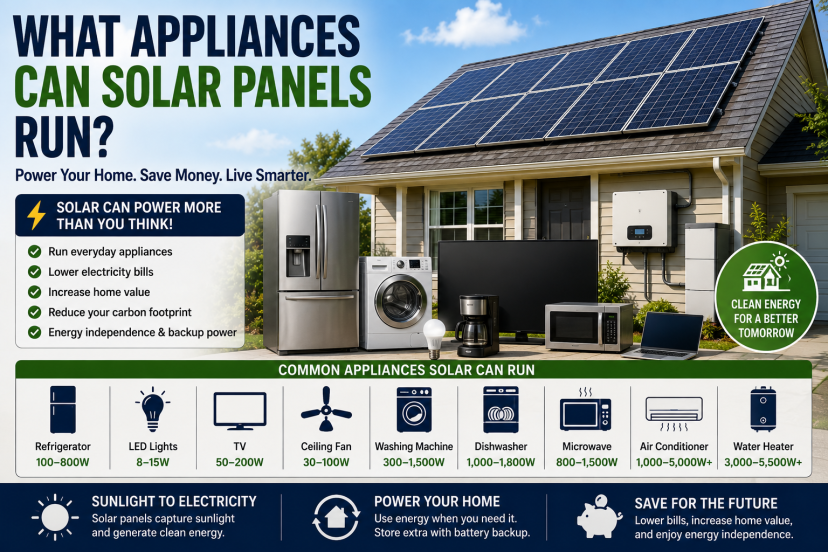
⚡ Common Appliances Solar Panels Can Help Power
When homeowners ask what appliances can solar panels run, they’re often surprised by how broad the answer is.
Solar electricity can support virtually any normal electrical household load when the overall system is appropriately designed.
Common examples include:
- Refrigerators And Freezers.
- LED Lights.
- Televisions.
- Computers.
- Wi-Fi Routers.
- Ceiling Fans.
- Washing Machines.
- Dishwashers.
- Microwaves.
- Coffee Makers.
- Electric Ovens.
- Clothes Dryers.
- Air Conditioners.
- Heat Pumps.
- Electric Water Heaters.
- Pool Pumps.
- EV Chargers.
However, these appliances don’t consume equal amounts of electricity.
A Wi-Fi router might use relatively little energy, while central air conditioning or electric resistance heating can create very large loads.
That’s why system sizing matters.
📊 Typical Appliance Power Requirements
The following examples illustrate why some appliances are easier to support than others. Actual wattage varies considerably by model, age, settings, and operating conditions.
| Appliance | Approximate Running Power |
|---|---|
| LED Light Bulb | 8–15 Watts |
| Wi-Fi Router | 5–20 Watts |
| Laptop Computer | 30–100 Watts |
| Television | 50–200 Watts |
| Refrigerator | 100–800 Watts While Running |
| Ceiling Fan | 30–100 Watts |
| Microwave | 800–1,500+ Watts |
| Washing Machine | 300–1,500+ Watts |
| Dishwasher | 1,000–1,800+ Watts During Heating |
| Coffee Maker | 800–1,500+ Watts |
| Electric Water Heater | 3,000–5,500+ Watts |
| Clothes Dryer | 2,000–6,000+ Watts |
| Central Air Conditioner | Several Thousand Watts |
These are only general ranges.
Always check the appliance’s label, owner’s manual, or manufacturer specifications when planning an electrical or backup system.
🧮 Watts Vs. Watt-Hours: Why The Difference Matters
Understanding what appliances can solar panels run becomes much easier once you understand two basic measurements.
Watts measure power.
Watt-hours or kilowatt-hours measure energy used over time.
Imagine an appliance drawing 1,000 watts for two hours.
Its energy consumption would be approximately:
1,000 watts × 2 hours = 2,000 watt-hours
That’s:
2 kWh
Your solar system must generate enough total energy over time, but your inverter and battery must also be capable of delivering enough power at a particular moment.
This distinction becomes especially important for backup systems.
A battery might contain enough stored energy to run several appliances for hours but still be unable to start a large air conditioner if the instantaneous power demand exceeds its output capability.
🧊 Can Solar Panels Run A Refrigerator?
Yes. Refrigerators are one of the most common household loads supported by solar energy.
In a grid-connected home, the refrigerator can consume electricity while your solar array produces power during the day, with the grid filling any shortfall when necessary.
During an outage, things become different.
If you want to keep the refrigerator operating when the grid is down, you generally need an appropriately configured backup system that may include battery storage, compatible inverter equipment, automatic controls, and a backed-up electrical circuit.
Refrigerators also have compressor startup demands that can be higher than normal running power.
A professional battery design should account for both.

❄️ Can Solar Panels Run Air Conditioning?
Yes, but air conditioning is one of the more demanding household loads.
A properly sized grid-connected solar array can produce electricity that offsets some or potentially a large share of the energy consumed by an air-conditioning system.
This can be particularly useful because air-conditioning demand often occurs during sunny periods when solar production is relatively strong.
However, powering central air conditioning during a grid outage is much more challenging.
The backup system needs enough:
- Battery Capacity.
- Inverter Output.
- Startup Capability.
- Solar Production.
- Stored Energy.
High-efficiency heat pumps and variable-speed air conditioners may be easier to integrate into a home-energy strategy than older, inefficient HVAC equipment.
Improving HVAC efficiency before sizing solar can also reduce the number of panels needed.
🔥 What About Electric Water Heaters And Clothes Dryers?
Solar electricity can offset the energy used by electric water heaters and clothes dryers, but both can be large electrical loads.
Traditional electric resistance water heaters commonly use several thousand watts while their heating elements operate.
Electric clothes dryers can also demand several kilowatts.

If you’re designing a battery backup system, running several high-power appliances simultaneously can drain stored energy quickly.
For example, operating an electric dryer, water heater, oven, and central AC at the same time could create a very large load.
A smarter approach during outages is often to prioritize essential appliances and delay nonessential high-energy tasks until grid power returns.
🔋 Solar Panels Vs. Solar Batteries During A Power Outage
This is one of the most misunderstood parts of residential solar.
Many homeowners assume that if the sun is shining, rooftop solar will automatically keep the house running when the utility grid goes down.
Most conventional grid-tied systems shut down during outages unless specifically designed with approved equipment that can safely provide backup power.
This protects utility workers and prevents unsafe power from being sent onto lines being repaired.
For backup capability, a system may require:
- Battery Storage.
- Compatible Inverter Equipment.
- Automatic Transfer Or Isolation Equipment.
- Critical-Load Panel Or Load Controls.
- Proper System Configuration.
Some newer systems offer specialized daytime backup capabilities, but homeowners should never assume this feature is included.
Ask the installer exactly what happens when the grid fails.
🔌 What Appliances Should You Prioritize During An Outage?
If resilience is your main goal, don’t automatically design a backup system to run everything in your home.
Prioritizing critical loads can make battery storage more practical and affordable.
A typical essential-load strategy might include:
- Refrigerator.
- Freezer.
- Selected Lights.
- Wi-Fi And Communications.
- Phone Charging.
- Medical Or Essential Equipment.
- Garage Door Or Security Equipment.
- Selected Outlets.
Depending on battery size, you may also include a heat pump, well pump, microwave, or other larger appliances.
Whole-home backup is possible with some systems, but it generally requires significantly more storage and power capacity than backing up a few critical circuits.
🌞 How Many Solar Panels Do You Need To Run Appliances?
There is no fixed number because households use electricity differently.
Start with your annual electricity consumption.
Suppose your home uses:
12,000 kWh per year
That’s roughly:
1,000 kWh per month
A solar installer can use your location, roof orientation, shading, panel specifications, and system losses to estimate the solar capacity needed to offset a desired portion of that electricity.
For example, one house might need an 8-kW system while another consuming the same amount of electricity might need a different size because local solar conditions differ.
Panel count then depends on panel wattage.
An 8.6-kW array using 430-watt panels would contain:
8,600 ÷ 430 = 20 panels
The important number isn’t simply panel count. It’s expected annual electricity production.
🏚️ Your Roof Determines How Much Solar You Can Install
Before deciding what appliances can solar panels run, make sure your roof can support the solar capacity you want.
Installers should evaluate:
- Available Roof Area.
- Roof Orientation.
- Shading.
- Roof Pitch.
- Roofing Material.
- Structural Condition.
- Roof Age.
- Remaining Roof Life.
A large household with significant air-conditioning and EV charging needs may require a substantial solar array.
If usable roof area is limited, higher-efficiency or higher-wattage panels may help provide more capacity within the available space.
Ground-mounted solar may be another option for suitable properties.
Most importantly, don’t install a long-lived solar array over a roof that’s likely to need replacement soon.
💵 Can Running Appliances On Solar Save Money?
Potentially, yes.
Solar electricity used directly by your household can reduce the amount of electricity purchased from the utility.
The financial benefit depends on:
Solar Installation Cost + Financing Costs – Incentives – Electricity Savings
Utility rate structures are also important.
If exported solar electricity receives a lower credit than electricity purchased from the utility costs, using more solar energy directly inside the home may increase its value.
Some homeowners adjust appliance use accordingly—for example, running the dishwasher, washing machine, or EV charger during periods of strong solar production when practical.
The best strategy depends on your utility’s rate plan and solar compensation rules.
💰 Solar Incentives And Battery Programs
Available incentives may reduce the cost of qualifying solar and battery installations.
Depending on current federal law and your individual circumstances, residential clean-energy tax incentives may apply to eligible solar or battery projects.
Some states and utilities also offer:
- Solar Rebates.
- Battery Storage Incentives.
- State Tax Benefits.
- Property Tax Provisions.
- Time-Of-Use Programs.
- Demand-Response Programs.
Programs and eligibility requirements change, so verify current information through official federal, state, and utility sources.
Consult a qualified tax professional regarding tax-credit eligibility.
🧰 Make Your Appliances More Solar-Friendly
One way to get more value from solar isn’t adding more panels—it’s reducing the electricity your appliances consume.
Consider energy-efficient upgrades when existing equipment needs replacement.
ENERGY STAR-certified products can help homeowners identify efficient appliances in many categories.
Other strategies include:
- Use LED Lighting.
- Maintain HVAC Equipment.
- Improve Air Sealing And Insulation.
- Consider High-Efficiency Heat Pumps.
- Use Efficient Water Heating.
- Reduce Standby Electricity Consumption.
- Schedule Flexible Loads Strategically.
Lower energy consumption can reduce the solar and battery capacity required to meet your goals.
👷 When To Call A Professional
Contact a qualified solar installer or electrician if you want solar or battery equipment designed around specific appliances, especially central air conditioning, electric heating, well pumps, EV chargers, electric water heaters, or whole-home backup.
A roofing professional should inspect an aging, leaking, damaged, or questionable roof before solar installation.
Your installer should also perform a proper electrical load analysis and explain exactly which appliances can operate during a grid outage and for approximately how long under the modeled conditions.
❓ Frequently Asked Questions
1. Can Solar Panels Run All Appliances In A House?
Yes, a properly sized solar system can generate enough electricity over time to offset energy used by many or potentially all household appliances. Running everything during an outage, however, usually requires substantial battery and inverter capacity.
2. Can Solar Panels Power A House At Night?
Solar panels don’t generate meaningful electricity at night. A grid-connected home normally uses utility electricity after solar production stops. A properly designed battery system can use stored solar energy at night.
3. Can Solar Panels Run An Air Conditioner?
Yes. Solar electricity can offset energy consumed by an air conditioner. Running central AC during an outage requires a backup system capable of handling its running and startup power requirements.
4. Can Solar Panels Run A Refrigerator During A Power Outage?
Only if the solar system is configured for backup operation. Standard grid-tied solar generally shuts down during an outage. Batteries and compatible backup equipment can keep selected refrigerator circuits operating.
5. How Many Solar Panels Does It Take To Run A Refrigerator?
There’s no useful universal number. Refrigerator energy use varies, and solar production changes throughout the day. Size the overall system using daily energy consumption, local solar production, inverter requirements, and desired backup duration.
6. What Appliances Use The Most Solar Power?
Large electric loads such as central air conditioners, resistance heaters, electric water heaters, clothes dryers, electric ranges, pool equipment, and EV chargers can consume substantial amounts of electricity.
7. Do I Need A Battery To Run Appliances With Solar Panels?
Not during normal grid-connected operation. Your solar system and utility grid can work together to serve household loads. Battery storage becomes particularly important if you want backup electricity during outages or want to store solar energy for later use.
🌞 Final Thoughts: Solar Can Power Much More Than You Might Think
So, what appliances can solar panels run? With a properly sized system, solar-generated electricity can support everything from refrigerators and televisions to heat pumps, electric water heaters, dryers, and EV chargers.
The real limitations come from system size, solar production, inverter capacity, roof space, electricity consumption, and—during outages—battery storage and backup configuration.
Start by reviewing 12 months of electric bills and identifying the appliances you consider essential. Then compare several professional solar proposals based on expected annual production, not simply the number of panels.
If your roof is aging or damaged, get a professional roof inspection or quote before installing solar. Combining a healthy roof, efficient appliances, well-designed solar, and appropriately sized battery storage can create a home that’s more energy-efficient, affordable to operate, and resilient when the grid goes down.
Disclaimer: This article is for general informational purposes only. Appliance power requirements, solar production, equipment compatibility, costs, incentives, tax rules, utility programs, and backup performance vary. Always consult appropriately licensed solar, roofing, electrical, tax, and other professionals before installing or modifying home energy systems.
 Explore more:
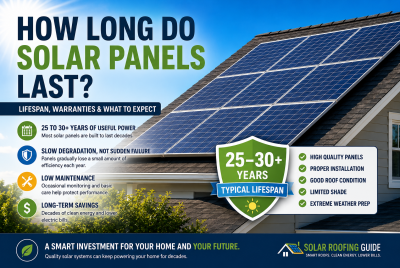
- How Long Do Solar Panels Last? Lifespan And Warranties
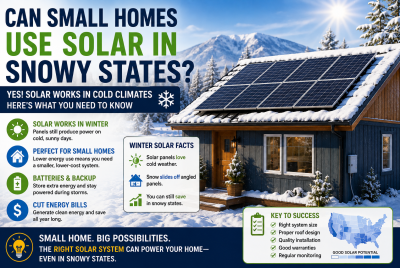
- Can Small Homes Use Solar In Snowy States?
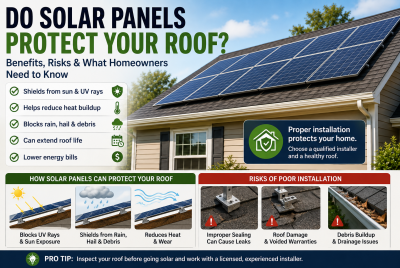
- Do Solar Panels Protect Your Roof?