Is Now A Good Time To Install Solar Panels? What U.S. Homeowners Should Know In 2026
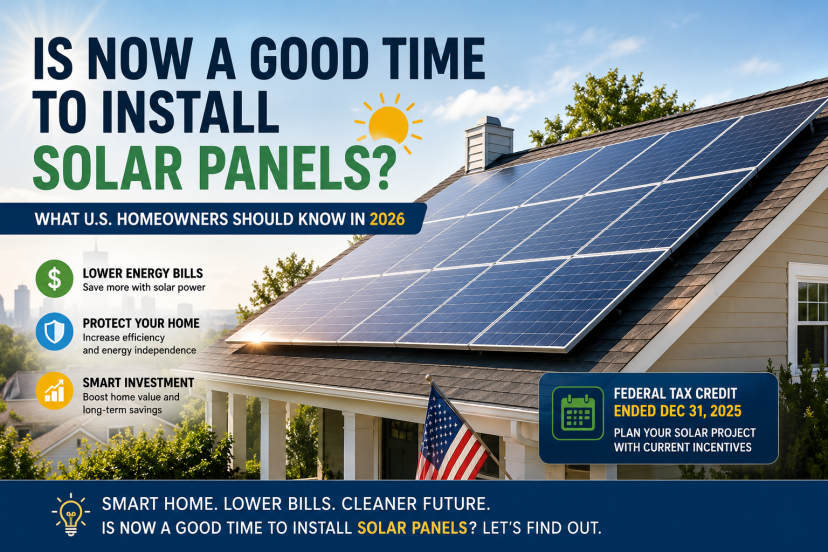
If your electricity bill keeps climbing, you may be wondering, is now a good time to install solar panels? For many U.S. homeowners, the answer can still be yes—but the solar decision in 2026 looks different than it did just a few years ago.
Solar panel prices have become more competitive over the long term, modern panels can produce electricity for decades, and rising utility rates can make generating your own power increasingly attractive. However, homeowners also need to consider roof condition, financing costs, local electricity prices, net metering rules, and available state or utility incentives.
One major change is especially important: the federal Residential Clean Energy Credit for homeowner solar installations ended for expenditures after December 31, 2025.
That makes careful planning more important than ever. Here is how to decide whether installing solar panels in 2026 makes sense for your home and budget.
☀️ Quick Answer: Is Now A Good Time To Install Solar Panels?
Is now a good time to install solar panels? It can be, especially if you have high electricity rates, a sunny and relatively unshaded roof, favorable local incentives, and plan to stay in your home long enough to recover the installation cost.
However, homeowners should calculate savings using current 2026 incentives, not older estimates that assume a 30% federal homeowner solar tax credit. Compare several local quotes, examine your roof first, and calculate the expected payback period before signing a contract.
Key Takeaways
- Most likely cause: Homeowners asking is now a good time to install solar panels are usually trying to balance rising electricity costs against installation costs and changing incentives.
- Usually serious? No, but installing solar is a major financial and home-improvement decision that deserves careful comparison.
- First thing to check: Review your last 12 months of electricity usage, utility rates, roof age, roof orientation, shade, and current state and utility incentives.
- Best solution: Get at least three detailed solar estimates and compare system size, estimated production, warranties, financing terms, roof work, and long-term savings before choosing an installer.
💰 Why 2026 Can Still Be A Good Time To Go Solar
The end of the federal homeowner solar tax credit does not automatically make residential solar a bad investment.
The real value of solar comes from producing electricity that you would otherwise purchase from your utility company. If electricity is expensive in your area, a properly sized solar energy system may substantially reduce the amount of grid electricity you buy.

Solar can be particularly attractive when:
- Electricity Rates Are High: Every kilowatt-hour generated on your roof can reduce your exposure to utility electricity prices.
- Your Roof Gets Strong Sunlight: South-, southwest-, and west-facing roof areas can often provide good solar production, although exact performance varies.
- Your State Offers Incentives: Rebates, property-tax exemptions, renewable energy certificates, or other programs may improve project economics.
- Your Utility Has Favorable Solar Rules: Net metering or other export-compensation programs can increase the value of excess solar production.
- You Plan To Stay: A longer ownership period gives you more time to recover your upfront investment.
So, is now a good time to install solar panels? Your location and household economics matter far more than the calendar alone.
🏠 Check Your Roof Before Installing Solar Panels
Your roof should be one of the first things you evaluate.
Modern solar panels may remain productive for 25 years or longer. Installing them on a roof that needs replacement in five years could mean paying to remove and reinstall the array when the roofing work is performed.
Before signing a solar contract, have the roof checked for:
- Roof Age
- Missing Or Damaged Shingles
- Leaks Or Moisture Damage
- Sagging Or Structural Concerns
- Flashing Problems
- Remaining Roof Service Life
If your asphalt-shingle roof is approaching the end of its expected life, replacing the roof before installing solar panels may make more financial sense.
Does A New Roof Qualify For A Solar Tax Credit?
Be careful with claims that a conventional new roof automatically qualifies as part of a solar tax credit.
Historically, the IRS stated that traditional roofing materials and structural components generally did not qualify for the Residential Clean Energy Credit simply because they supported solar panels. Certain solar roofing products that actually generate electricity were treated differently.
More importantly, that homeowner federal clean-energy credit is no longer available for expenditures after December 31, 2025.
💵 How Much Do Solar Panels Cost In 2026?
There is no single national price that every homeowner should expect to pay.
Your solar installation cost depends on:
| Cost Factor | Why It Matters |
|---|---|
| System Size | Larger systems require more panels and equipment |
| Panel Efficiency | Higher-efficiency panels may cost more |
| Roof Design | Complex roofs may require additional labor |
| Electrical Work | Older homes may require electrical upgrades |
| Battery Storage | Batteries can significantly increase project cost |
| Local Labor | Installation costs vary by region |
| Permitting | Local permit and inspection costs differ |
| Financing | Loan rates and fees affect total ownership cost |
Instead of focusing only on the advertised system price, compare the cost per watt, expected annual electricity production, cash price, financed price, warranties, and estimated lifetime savings.
A cheap system that produces less electricity or comes with weak warranties is not necessarily the better deal.
⚡ What Happened To The Federal Solar Tax Credit?
This is one of the most important changes for homeowners researching solar in 2026.
The Residential Clean Energy Credit previously provided a 30% federal income tax credit for qualified residential solar installations from 2022 through 2025. ENERGY STAR and IRS guidance confirm that the credit ended after December 31, 2025.
Under current IRS guidance, homeowners cannot claim the Section 25D credit for a system completed after December 31, 2025 simply because they paid for it before that deadline.
Therefore, homeowners evaluating solar today should not assume a 30% federal residential tax credit in their savings calculation.
Look For State And Local Solar Incentives
The federal change makes local programs more important.
Depending on where you live, potential solar incentives may include:
- State Rebates
- Utility Rebates
- Property-Tax Exemptions
- Sales-Tax Exemptions
- Performance-Based Incentives
- Solar Renewable Energy Certificates
- Local Financing Programs
Programs can change quickly, so verify incentives directly with your state energy office, utility company, and qualified tax professional before making financial decisions.
📊 Solar Panels Vs. Staying With Utility Electricity
A simple comparison can help answer is now a good time to install solar panels for your household.
| Solar Panels | Utility-Only Electricity |
|---|---|
| Higher upfront investment | Little or no upfront investment |
| Produces electricity at home | Electricity purchased from utility |
| May reduce monthly electric bills | Full exposure to utility rates |
| Requires suitable roof or property | No solar-compatible roof required |
| May offer decades of production | Continuous monthly electricity expense |
| Maintenance is generally limited | Utility maintains generation infrastructure |
| Savings depend on local policies | Cost depends heavily on utility rates |
Solar becomes more appealing when the long-term cost of generating your own electricity compares favorably with buying electricity from the grid.
🔋 Should You Add A Solar Battery?
Solar batteries are becoming an increasingly important part of the residential solar conversation.
A battery stores electricity produced by your panels so it can be used later. Depending on the system design, battery storage may also provide backup power when the electrical grid goes down.
A battery can be worth considering if:
- Your area experiences frequent power outages.
- Your utility pays relatively little for exported solar electricity.
- You want greater home energy resilience.
- You want to use more of your solar electricity after sunset.
- Time-of-use electricity rates make evening electricity expensive.
However, batteries add substantial cost. If your main goal is simply achieving the shortest possible solar payback period, solar panels without battery storage may sometimes provide better economics.
📉 How To Calculate Your Solar Payback Period
Before installing solar panels, estimate how many years it may take for your energy savings to recover your net system cost.
A simplified calculation is:

Solar Payback Period = Net Solar Cost ÷ Estimated Annual Savings
For example, imagine a system costs $20,000 after all currently available rebates and incentives and saves approximately $2,000 per year.
$20,000 ÷ $2,000 = 10-year estimated payback
After the system reaches its payback point, continued electricity production can provide additional financial value.
Real-world calculations are more complicated because electricity prices, solar production, panel degradation, maintenance, financing costs, insurance, utility policies, and export rates can change.
Ask installers to clearly show the assumptions behind any 20- or 25-year savings projection.
🛠️ How To Choose The Right Solar Installer
A quality installation is just as important as choosing good solar panels.
Get at least three quotes from experienced installers and compare the entire proposal—not just the monthly payment.
Ask each contractor about:
- Licensing And Insurance
- Years In Business
- Roof Penetration Methods
- Workmanship Warranty
- Panel Warranty
- Inverter Warranty
- Estimated Annual Production
- Monitoring Equipment
- Permitting And Inspections
- Who Handles Warranty Claims
Be especially cautious when a salesperson focuses almost entirely on a low monthly payment without clearly showing the cash price, financing fees, interest rate, total repayment cost, and expected electricity production.

🛡️ Solar Panel Warranties And Maintenance
Solar systems generally require relatively little routine maintenance because panels have no moving parts.
Homeowners should still periodically check system monitoring data for unexpected drops in production. Trees may need trimming if new shade develops, and panels may occasionally require cleaning in dusty environments.
Common warranties may include:
Product Warranty: Covers manufacturing defects.
Performance Warranty: Guarantees that panels will retain a specified level of output over time.
Inverter Warranty: Covers one of the system’s most important electrical components.
Workmanship Warranty: Covers certain installation-related problems.
Read the actual warranty documents instead of relying only on the salesperson’s description.
🌎 Is Solar Worth It Without The Federal Tax Credit?
Potentially, yes.
The loss of the federal homeowner credit increases the effective cost of going solar compared with a similar installation that qualified in 2025. But solar economics have always varied dramatically by household and location.
A homeowner with high electricity rates, strong sunlight, an excellent roof, favorable state incentives, and a long ownership horizon may still see attractive savings.
A homeowner with cheap electricity, heavy tree shade, an aging roof, unfavorable export rates, or expensive financing may be better off waiting or pursuing other energy-efficiency upgrades first.
That is why is now a good time to install solar panels cannot be answered solely by looking at national trends.
👷 When To Call A Professional
Contact a licensed roofing contractor if your roof is aging, leaking, sagging, or showing significant shingle damage before installing solar.
You should also consult a qualified solar installer when you need a detailed shade analysis, system design, structural evaluation, electrical assessment, production estimate, or battery recommendation.
For major projects, consider getting the roof evaluated independently rather than relying entirely on the company selling the solar system.
❓ Frequently Asked Questions
Is 2026 A Good Year To Install Solar Panels?
It can be. Solar may still make financial sense in 2026 for homeowners with high electricity rates, suitable roofs, good sunlight, favorable local incentives, and enough time to recover their investment. Calculate savings without assuming the expired federal homeowner solar credit.
Is The 30% Federal Solar Tax Credit Still Available In 2026?
No. Current IRS guidance states that the Residential Clean Energy Credit is not available for expenditures after December 31, 2025.
Is It Better To Replace My Roof Before Getting Solar?
If your roof is nearing the end of its useful life, replacing it first is often practical. Otherwise, you could later face the additional expense of removing and reinstalling solar panels to replace the roof.
How Long Does It Take For Solar Panels To Pay For Themselves?
Payback periods vary considerably. System price, electricity rates, available incentives, solar production, financing, net metering, and household electricity consumption all affect the result. Request a customized calculation based on your actual utility bills.
Do Solar Panels Work During A Power Outage?
Most standard grid-connected solar systems automatically shut down during an outage for safety. A properly designed solar-plus-battery system may provide backup electricity to selected circuits or the home, depending on its configuration.
Are Solar Panels Worth It If I Plan To Move?
They can be, but the calculation becomes more complicated. If you expect to move soon, compare your projected savings before selling with the potential effect of an owned solar system on your home’s marketability. Pay particular attention to solar loans or leases that may complicate a sale.
What Is The Best Time Of Year To Install Solar Panels?
Solar can be installed during much of the year. The best time may depend on contractor availability, weather, roof condition, permitting timelines, and local incentives. Starting before peak installation seasons may sometimes make scheduling easier.
🌞 Final Verdict: Is Now A Good Time To Install Solar Panels?
For the right house, now can still be a good time to install solar panels, even though the financial equation changed significantly when the federal Residential Clean Energy Credit ended after 2025.
Start with your roof. Then gather 12 months of electricity bills, research current state and utility incentives, and request at least three solar proposals. Compare the cash price, financing cost, expected annual production, warranties, local electricity rates, and realistic payback period.
If your roof needs replacement soon, consider coordinating roofing and solar work so you do not have to remove the panels several years later.
Solar should not be an impulse purchase. When the numbers work, however, a well-designed solar energy system can reduce dependence on utility electricity and help create a more efficient and resilient home for decades.
Disclaimer: Solar pricing, utility policies, rebates, tax rules, and incentives vary by location and can change. Always verify current programs and consult licensed solar and roofing professionals and a qualified tax professional before making financial or installation decisions.
Explore more:
- How Long Do Solar Panels Last? Lifespan And Warranties
- What Appliances Can Solar Panels Run?
- Do Solar Panels Protect Your Roof?