How Many Solar Panels Do I Need For My House? A Simple Homeowner Calculation
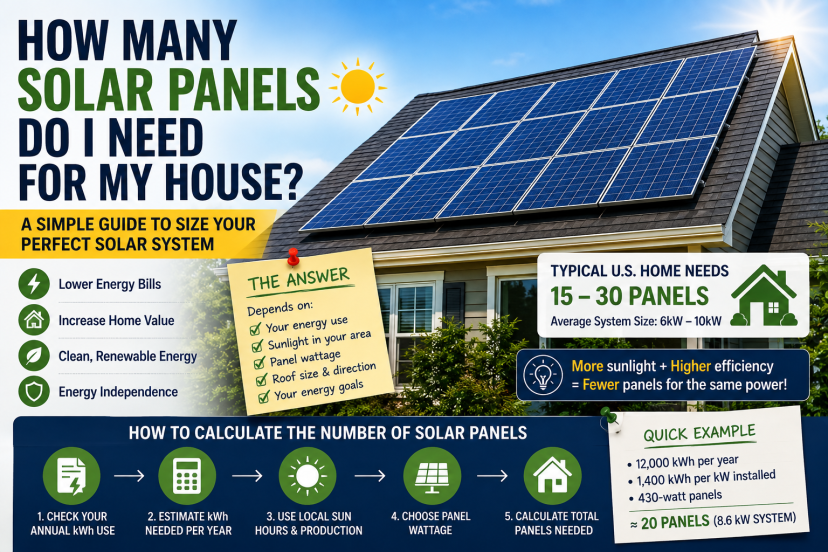
If you’re thinking about going solar, one of the first questions you’ll probably ask is, “How many solar panels do I need for my house?” The answer isn’t based on your home’s square footage alone. Your electricity consumption, local sunlight, roof orientation, shading, panel wattage, and energy goals all affect the size of the solar system you may need.
For many U.S. homes, a residential solar array might contain roughly 15 to 30 panels, but your home could need fewer or more. A family with an electric vehicle, heat pump, pool, or high air-conditioning use may require substantially more electricity than a similar-sized household.
The good news is that you can make a useful preliminary estimate using your annual electricity consumption and expected solar production. From there, a qualified solar installer can evaluate your roof and create a system designed around your actual energy needs.
How Many Solar Panels Do I Need For My House?
How many solar panels do I need for my house? Many U.S. homes may need roughly 15–30 modern solar panels, but the correct number depends on annual electricity use, panel wattage, local sunlight, shading, roof orientation, and desired energy offset. For example, a 9-kW system using 450-watt panels would require about 20 panels. Your utility bills and annual kilowatt-hour consumption are the best places to start.
Key Takeaways
Most likely cause: The number of panels your home needs is primarily driven by how much electricity you use and how much electricity each installed panel can produce at your location.
Usually serious? No. You don’t need an exact number before requesting solar quotes. A professional system design can account for your roof, sunlight, shading, utility rules, and electricity consumption.
First thing to check: Look at your electric bills and find your total electricity consumption for the past 12 months, measured in kilowatt-hours (kWh).
Best solution: If you’re asking how many solar panels do I need for my house?, calculate your annual energy use first, then compare several professional solar designs based on realistic production estimates rather than panel count alone.
🏠 What Determines How Many Solar Panels You Need?
Two houses that look almost identical can require very different solar systems.
That’s because solar isn’t normally sized according to the number of bedrooms or square footage of the house. Installers are much more interested in electricity consumption and the site’s solar potential.
The main factors include:
- Annual Electricity Use: Higher consumption generally requires a larger solar system.
- Panel Wattage: Higher-wattage panels can generate more power under rated conditions.
- Local Sunlight: Solar production varies significantly by location and weather.
- Roof Orientation: Roof sections receiving better solar exposure can produce more electricity.
- Roof Pitch: The panel angle influences annual production.
- Shading: Trees, chimneys, and nearby buildings can reduce output.
- System Losses: Inverters, wiring, temperature, and other factors reduce real-world production.
- Energy Goals: Some homeowners want to offset nearly all annual electricity consumption, while others want a smaller system.
Understanding these variables helps explain why a simple “20 panels per house” rule doesn’t work for everyone.
⚡ Start With Your Annual Electricity Consumption
When figuring out how many solar panels do I need for my house, don’t begin with the roof.
Begin with your electric bill.
Find your electricity consumption for the previous 12 months and add the monthly figures together. Some utilities already provide a rolling annual total.
Electricity consumption is measured in kilowatt-hours (kWh).
Suppose your household uses:
12,000 kWh per year
That’s an average of about:
1,000 kWh per month
Your solar installer can use this information along with local solar-resource data to estimate the system capacity needed to generate your target amount of electricity.
Using a full year is better than using one month because electricity consumption often changes dramatically between seasons.
🧮 How To Calculate Your Estimated Solar Panel Needs
A rough solar calculation can help you understand the quotes you receive.
One simplified approach is:
Annual electricity needed ÷ estimated annual production per installed kW = required system size
Then:
Required system watts ÷ panel wattage = approximate number of panels
Example Solar Calculation
Imagine your home uses 12,000 kWh annually.
If a preliminary estimate suggests each installed kilowatt of solar at your location could generate around 1,400 kWh annually:
12,000 ÷ 1,400 = 8.57 kW
You might therefore consider roughly an 8.6-kW system before making other adjustments.
If the installer uses 430-watt panels:
8,600 watts ÷ 430 watts = 20 panels
That gives you an approximate 20-panel array.
This is only an example. Actual production varies with location, weather, roof direction, shading, system losses, equipment, and installation design.
📊 Solar Panels Needed By System Size
Here is a simple comparison using 430-watt panels:
| Solar System Size | Approximate Number Of 430W Panels |
|---|---|
| 5 kW | 12 |
| 6 kW | 14 |
| 7 kW | 17 |
| 8 kW | 19 |
| 9 kW | 21 |
| 10 kW | 24 |
| 12 kW | 28 |
| 15 kW | 35 |
Numbers are rounded up where necessary.
This table shows why panel wattage matters. A homeowner using lower-wattage modules may need more individual panels to reach the same total system capacity.
🌎 Your Location Can Change The Number Of Panels You Need
Solar panels installed in different parts of the United States won’t necessarily generate the same amount of electricity annually.
A sunny, unshaded roof in Arizona may have a different annual production profile from a roof in Washington state, New York, or Maine.

However, this doesn’t mean solar only works in hot climates.
Solar panels generate electricity from sunlight, not heat. In fact, excessive heat can reduce the instantaneous efficiency of photovoltaic modules.
The important factors are the amount of usable solar energy reaching your panels throughout the year and the characteristics of your installation.
Tools such as NREL’s PVWatts Calculator can help homeowners estimate solar electricity production based on location and basic system information.
A professional installer can then perform a more detailed site-specific analysis.
🌳 How Roof Direction And Shading Affect Solar Panel Count
Your roof plays a major role when determining how many solar panels do I need for my house?
An unobstructed roof area with strong solar exposure can produce more electricity than a heavily shaded area.
Installers should evaluate shading from:
- Trees.
- Chimneys.
- Dormers.
- Nearby houses.
- Utility structures.
- Other roof sections.
South-facing roof areas have traditionally been attractive for maximizing annual production in much of the Northern Hemisphere, but east- and west-facing arrays can also be practical.
Your electricity-use pattern and local utility rate structure may also influence the best panel orientation.

Don’t remove healthy shade trees automatically just to install more solar. Ask the installer to model the production difference first.
📐 How Much Roof Space Do Solar Panels Need?
Knowing that you need 20 panels doesn’t help if only 14 will fit on the usable portion of your roof.
Modern residential solar modules vary in size, but many occupy roughly 20–25 square feet each, depending on the model.
Twenty panels could therefore occupy around 400–500 square feet of panel surface area alone.
Actual roof-area requirements can be greater because installers must account for layout, roof edges, ridges, valleys, vents, fire-access pathways, setbacks, and local codes.
A roof may look large from the ground but have relatively little usable solar space.
That’s why accurate roof measurements are essential.
What If You Don’t Have Enough Roof Space?
Possible options include:
- Using higher-efficiency or higher-wattage panels.
- Installing panels on another suitable roof section.
- Considering a detached garage or accessory structure.
- Evaluating a ground-mounted solar array where practical.
- Reducing household electricity consumption before sizing solar.
Energy efficiency can sometimes be cheaper than adding additional solar capacity.
💡 Improve Energy Efficiency Before Adding More Panels
Before asking how many solar panels do I need for my house, consider whether your home is wasting electricity.
Reducing consumption can potentially reduce the size and cost of the solar system needed to offset a given percentage of your use.
Depending on the home, improvements might include:
- ENERGY STAR-certified appliances where replacement makes sense.
- LED lighting.
- Air sealing.
- Improved insulation.
- Efficient heat pumps.
- Smart thermostats.
- Better HVAC maintenance.
- Efficient water heating.
For example, reducing annual electricity consumption from 12,000 kWh to 10,000 kWh could allow for a smaller solar system, depending on your desired energy offset and local conditions.
Think of efficiency as the first layer and solar generation as the next.
🚗 Plan For Future Electricity Consumption
Don’t size your solar array only around today’s electricity bill if you expect major lifestyle changes.
Your electricity use could increase if you’re planning to add:
- An Electric Vehicle.
- A Heat Pump.
- Electric Water Heating.
- A Pool Or Hot Tub.
- A Home Addition.
- An Accessory Dwelling Unit.
- Battery Storage Or Other Electrical Equipment.
For example, switching from gasoline vehicles to an EV moves some of your transportation energy consumption onto your electric bill.
Tell your solar installer about these plans.
At the same time, bigger isn’t automatically better. Local utilities may limit system size or compensate exported solar electricity differently from electricity you consume directly.
System design should reflect both your current and expected future needs.
🔋 Do You Need More Solar Panels With A Battery?
Adding battery storage doesn’t automatically mean you need more panels.
The solar array produces electricity. The battery stores a portion of that electricity for later use.
However, your energy goals may change when adding storage.
If you want substantial backup capability or want solar to recharge batteries while also supplying household loads, the installer needs to consider your desired backup loads, battery capacity, system configuration, and expected solar production.
A battery designed to keep a refrigerator, lights, internet equipment, and a few outlets operating is very different from a system intended to support whole-home loads.
Discuss backup expectations before selecting either panel count or battery size.
🏚️ Check Your Roof Before Installing 20+ Solar Panels
A solar array can remain on your roof for decades, so roof condition is critical.
Before installation, inspect:
- Shingle Condition.
- Roof Age.
- Existing Leaks.
- Flashing.
- Roof Deck.
- Structural Condition.
- Remaining Roof Life.
If the roof is already approaching replacement age, replacing it before solar installation may save money later.
Otherwise, you could eventually need to pay to remove the solar array, replace the roofing, and reinstall the panels.
Ask both the roofer and solar installer how their warranties work when the two systems overlap.
💰 Do More Solar Panels Mean More Savings?
Not necessarily.
Adding panels increases electricity generation, but the financial value of that additional electricity depends on your utility’s rules.
Some utilities provide favorable credit for electricity exported to the grid. Others may compensate exported electricity at a lower rate than the retail electricity price.
Your ideal solar system therefore isn’t always the largest array that physically fits on your roof.
A good financial comparison considers:
Installation Cost + Financing + Maintenance – Incentives – Electricity Savings
Compare proposals using estimated annual production, total system cost, financing terms, and realistic utility-rate assumptions.
Avoid choosing a system based only on a salesperson’s projected monthly savings.
💵 Solar Incentives And Your System Size
Available federal, state, local, and utility incentives can affect the economics of your solar project.
Federal residential clean-energy tax incentives may apply to qualifying solar installations depending on current law and your circumstances. State governments and utilities may also offer rebates, tax benefits, battery incentives, or other programs.
Rules, eligibility, and incentive amounts can change.
Before making a purchase, verify current programs with official government or utility sources and consult a qualified tax professional when appropriate.
Incentives can make solar more affordable, but they shouldn’t be the only reason you choose a particular system size.
🛠️ How To Get A More Accurate Solar Panel Estimate
For a realistic answer to how many solar panels do I need for my house, get several professional proposals.
Ask each installer to provide:
- Recommended System Size.
- Exact Panel Model And Wattage.
- Number Of Panels.
- Estimated First-Year Production.
- Shading Assumptions.
- Roof Layout.
- Total Cash Price.
- Financing Terms.
- Equipment And Workmanship Warranties.
- Estimated Energy Offset.
If three installers recommend dramatically different system sizes for the same house, ask why.
A transparent contractor should be able to explain the calculation.
👷 When To Call A Professional
Contact a qualified solar installer when you want an accurate system design based on your roof, location, utility bills, shading, electrical service, and future energy needs.
You should also contact a qualified roofing professional before going solar if your roof is leaking, damaged, sagging, or approaching replacement age.
Addressing roofing problems first can help avoid the expense and inconvenience of removing solar panels for premature roof repairs.
❓ Frequently Asked Questions
1. How Many Solar Panels Do I Need For A 2,000-Square-Foot House?
Square footage alone doesn’t determine solar panel count. Two 2,000-square-foot homes can have very different electricity consumption. Use your annual kWh consumption, location, roof characteristics, and panel wattage for a more useful estimate.
2. Is 20 Solar Panels Enough To Power A House?
It can be. Twenty 430-watt panels create an 8.6-kW array. Whether that’s enough depends on annual electricity consumption and how much electricity the system produces at your location.
3. How Many Solar Panels Do I Need For 1,000 kWh Per Month?
A household consuming 1,000 kWh monthly uses approximately 12,000 kWh annually. Depending on location, roof conditions, system losses, and panel wattage, a system around 8–10 kW might be a reasonable preliminary estimate, but site-specific modeling is needed.
4. Can I Power My Entire House With Solar Panels?
Potentially. A properly sized solar system may generate electricity equivalent to a large portion or even all of a home’s annual electricity consumption. However, grid-connected solar without appropriate battery and backup equipment generally won’t power your house during a grid outage.
5. How Many Solar Panels Fit On My Roof?
That depends on usable roof dimensions, panel size, roof geometry, vents, chimneys, shading, setbacks, and local fire and building codes. A solar installer can create a detailed roof layout.
6. Is It Better To Have More Solar Panels Than You Need?
Not always. Oversizing can increase upfront costs, and exported electricity may be worth less than electricity consumed directly depending on utility policies. Size the system around your energy goals and local rules.
7. How Many Solar Panels Do I Need With A Battery?
Battery storage doesn’t determine panel count by itself. Your solar array should be sized around electricity consumption, solar production, backup goals, battery capacity, and utility rules.
🌞 Final Thoughts: Start With Your Electricity Bill, Not Your Roof Size
So, how many solar panels do I need for my house? For many U.S. homeowners, somewhere around 15–30 modern panels may be a useful starting range, but there is no universal number.
Your annual electricity consumption is the best place to begin.
Check the last 12 months of utility bills, consider future electricity needs, evaluate your roof condition, and then request several solar proposals. Compare system size, panel wattage, estimated annual production, roof layout, warranties, and total cost.
And if your roof is older or showing signs of deterioration, request a professional roof inspection or quote before installing solar. Getting the roof and solar design right from the beginning can help you build a more efficient, resilient home while avoiding expensive changes later.
Disclaimer: This article is for general informational purposes only. Solar production, system sizing, costs, incentives, utility policies, tax rules, roof requirements, and energy savings vary by home and location and may change. Consult appropriately licensed solar, roofing, electrical, tax, and other professionals before making home improvement or financial decisions.
Explore more:
- Solar For Small Homes: Is It Really Worth It
- How To Pick The Best Solar Kits For Small Homes
- What Happens If A Solar Panel Breaks?