What Should I Know Before Buying Solar Panels? 12 Things Every Homeowner Should Check
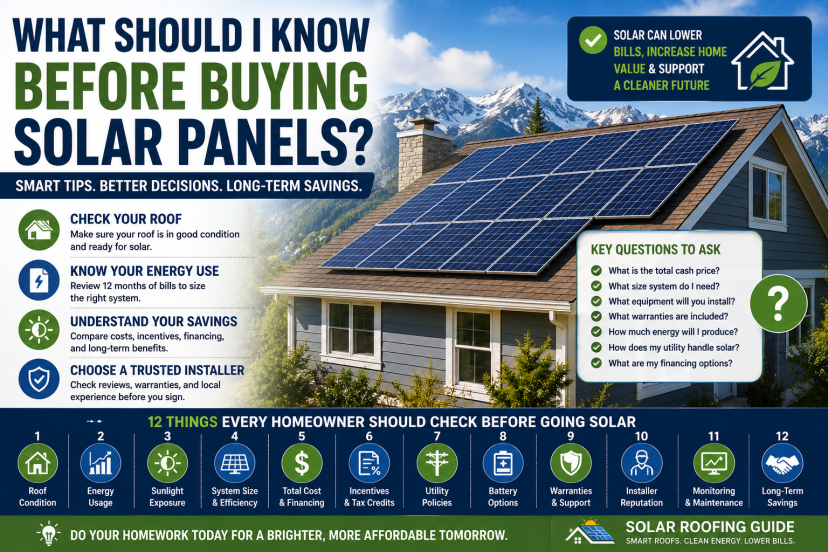
Solar panels can lower your dependence on utility electricity and provide decades of home-generated power—but buying the wrong system can turn a promising investment into an expensive headache. If you’re asking what should I know before buying solar panels, start with your house and electricity usage rather than a salesperson’s estimate of how much you might save.
Your roof condition, available sunlight, electricity rates, system size, financing method, utility rules, equipment quality, warranties, and installer can all affect whether solar makes financial sense.
U.S. homeowners also need to be careful with outdated information. The federal Residential Clean Energy Credit for homeowner solar expenditures ended after December 31, 2025, changing the economics of new installations in 2026.
Before signing a solar contract, take time to understand exactly what you’re buying, what it will cost, how much electricity it should produce, and who will support the system if something goes wrong.
☀️ Quick Answer: What Should I Know Before Buying Solar Panels?
What should I know before buying solar panels? Check your roof condition, 12 months of electricity usage, available sunlight, local utility rates, system size, panel and inverter warranties, financing terms, and current incentives.
Get at least three detailed quotes from qualified installers. Compare the cash price, expected annual kWh production, equipment specifications, warranties, and total financed cost—not simply the estimated monthly payment.
Key Takeaways
- Most likely cause: Homeowners asking what they should know before buying solar panels usually want to avoid overpaying, choosing the wrong system, or discovering roof and financing problems after signing.
- Usually serious? Potentially. Solar is a major home investment, and poor equipment, expensive financing, or an unsuitable roof can significantly reduce its value.
- First thing to check: Gather 12 months of electricity bills and evaluate your roof’s age, condition, shade, orientation, and remaining useful life.
- Best solution: Compare at least three itemized solar proposals showing the cash price, equipment, annual production estimate, warranties, financing terms, and realistic long-term savings.
🏠 1. Check Your Roof Before Buying Solar Panels
Your roof should be one of your first considerations.
Quality solar panels can continue producing useful electricity for 25 to 30 years or longer. Installing them over a roof that may need replacement in five years could create an avoidable expense.
When the roof eventually needs replacement, contractors may have to:
- Shut down the solar system.
- Remove the panels.
- Remove some mounting equipment.
- Replace the roofing.
- Reinstall the solar equipment.
- Inspect and reconnect the system.
Before buying solar, check for aging shingles, leaks, damaged flashing, sagging, structural concerns, and previous storm damage.
If the roof is near the end of its useful life, consider replacing it first.
⚡ 2. Understand How Much Electricity You Actually Use
Don’t size a solar system based on the square footage of your house.
Size it around electricity consumption and your goals.
Gather approximately 12 months of electric bills and determine how many kilowatt-hours (kWh) you use annually.
Also consider future changes.
Are you planning to:
- Buy an electric vehicle?
- Replace a gas furnace with a heat pump?
- Install a heat-pump water heater?
- Add a swimming pool?
- Build an addition?
- Work from home more often?
These changes could increase electricity consumption and affect the solar capacity that makes sense for your household.
🌳 3. Find Out How Much Sun Your Roof Gets
If you’re wondering what should I know before buying solar panels, sunlight exposure should be near the top of the list.
Solar panels can generate electricity on cloudy days, but heavy shade reduces production.
Potential obstacles include:
- Mature trees.
- Neighboring buildings.
- Chimneys.
- Dormers.
- Roof sections facing unfavorable directions.
- Nearby hills or terrain.
- Other rooftop equipment.
South-facing roofs often provide strong annual production in the Northern Hemisphere, but east- and west-facing arrays can also work well.
Don’t automatically reject your home because the roof doesn’t face perfectly south.
A professional solar assessment should model your specific roof rather than relying on a simple rule of thumb.
📐 4. Understand Solar Panel Efficiency And System Size
Solar panel efficiency describes how effectively a module converts incoming sunlight into electricity.
Higher-efficiency panels can be particularly useful when roof space is limited because they can produce more rated power within a given area.
However, the panel with the highest efficiency percentage is not automatically the best financial choice.
Compare:
| Factor | Why It Matters |
|---|---|
| Panel Wattage | Determines rated output per panel |
| Panel Efficiency | Important when roof space is limited |
| Product Warranty | Protects against qualifying defects |
| Performance Warranty | Covers long-term output expectations |
| Temperature Coefficient | Shows sensitivity to higher temperatures |
| Manufacturer | Affects warranty support and product history |
| Cost | Determines overall project economics |
Look at the entire system rather than chasing a single specification.
💰 5. Know The Real Price Before Signing
Solar advertisements sometimes emphasize a monthly payment instead of the total cost.
That can make an expensive system look deceptively affordable.
Ask every installer for the cash price, even if you plan to finance.
Then compare it with the financed price.
For example, two systems might both cost $150 per month, but one loan could have a longer repayment period, higher interest rate, or substantial financing fees.
Ask for:
- Cash Purchase Price
- Loan Principal
- Interest Rate
- APR
- Loan Term
- Financing Or Dealer Fees
- Total Of Payments
- Prepayment Rules
Never evaluate a solar loan based only on the monthly payment.
💵 6. Don’t Assume You Still Get A 30% Federal Solar Tax Credit
This is especially important for homeowners buying solar in 2026.

Older websites, videos, advertisements, and solar calculators may still discuss the 30% federal Residential Clean Energy Credit as if it were currently available for new homeowner installations.
Under current federal law and IRS guidance, the Section 25D Residential Clean Energy Credit ended for expenditures after December 31, 2025.
Therefore, a homeowner installing solar in 2026 should not automatically subtract 30% from the system price when calculating the payback period.
Other incentives may still exist, including:
- State Rebates
- Utility Rebates
- Property-Tax Exemptions
- Sales-Tax Exemptions
- Renewable Energy Certificates
- Local Energy Programs
Check current programs directly rather than relying solely on a salesperson’s estimate.
📊 7. Understand Your Utility’s Solar Rules
Generating electricity is only part of the financial equation.
You also need to understand what happens when your panels generate more electricity than your home is using.
Depending on the utility and state, excess electricity exported to the grid may receive retail-rate credits, reduced credits, avoided-cost compensation, or another rate.
Ask your utility:
- Is net metering available?
- How is exported solar electricity credited?
- Are there fixed monthly solar charges?
- Are time-of-use rates involved?
- Does the rate structure change after solar installation?
- Are there system-size restrictions?
- What interconnection fees apply?
Two identical solar systems can have very different financial results under different utility policies.

🔋 8. Decide Whether You Really Need A Solar Battery
Solar batteries can increase energy resilience, but they also increase system cost.
A battery may be attractive if:
- Your neighborhood experiences frequent outages.
- You want backup electricity.
- Your utility has unfavorable export compensation.
- You have time-of-use electricity pricing.
- You want to consume more of your solar electricity after sunset.
But remember an important point:
Solar panels alone usually do not keep a standard grid-tied home powered during an outage.
For safety, conventional grid-connected solar systems typically shut down when the grid fails. A properly designed battery-backed system can keep selected circuits—or potentially much of the home—operating depending on its capacity and configuration.
🛡️ 9. Compare Solar Warranties Carefully
If you’re researching what should I know before buying solar panels, don’t overlook warranty details.
There isn’t just one solar warranty.
Product Warranty
Covers qualifying manufacturing defects for the stated warranty period.
Performance Warranty
Guarantees that panels will retain a specified percentage of their rated output over time.
Inverter Warranty
Covers the inverter or microinverters, which may have different warranty periods from the panels.
Workmanship Warranty
Provided by the installer and may cover certain installation-related problems.
Ask an important question:
Who actually handles the warranty claim?
A 25-year warranty sounds impressive, but it is less useful if obtaining service is difficult or the original installer is no longer operating.
🔧 10. Research The Solar Installer, Not Just The Panels
Excellent equipment can still perform poorly if it is installed incorrectly.
Research the contractor carefully.
Look for appropriate licensing, insurance, experience, reviews, complaint history, and local installation experience.
Ask:
- Who performs the installation?
- Does the company use employees or subcontractors?
- Who obtains permits?
- Who handles utility interconnection?
- Who repairs roof leaks associated with installation?
- Who provides service after installation?
- How long has the company operated?
- What happens if the company closes?
Get everything important in writing.
📉 11. Calculate A Realistic Solar Payback Period
Solar payback is the approximate time required for accumulated energy savings to recover your net investment.
A simple formula is:
Net Solar Cost ÷ Estimated Annual Savings = Estimated Payback Period
Suppose a solar system costs $18,000 after any currently available rebates and incentives and saves an estimated $1,800 per year.
$18,000 ÷ $1,800 = 10 years
But real solar economics are more complicated.
Consider:
- Panel degradation.
- Electricity-rate changes.
- Inverter replacement.
- Maintenance.
- Financing interest and fees.
- Insurance changes.
- Utility policy changes.
- How long you expect to own the home.
Be cautious of savings projections that assume aggressive electricity-rate increases for decades.
🧾 12. Read The Contract Before You Sign
A solar contract can involve tens of thousands of dollars and potentially decades of financial obligations.
Read it carefully.
Make sure you understand:
- Total system price.
- Exact panel and inverter models.
- System size in kW.
- Estimated annual production.
- Installation timeline.
- Payment schedule.
- Warranty coverage.
- Roof responsibilities.
- Financing terms.
- Cancellation terms.
- Monitoring services.
- Maintenance obligations.
Do not rely on verbal promises that are absent from the written agreement.
If a salesperson pressures you to sign immediately because an offer supposedly expires that day, consider that a reason to slow down rather than speed up.
🌱 How Solar Panels Can Save Money Long Term
A quality solar system can produce electricity for decades.
The financial benefit comes primarily from replacing electricity that you would otherwise purchase from your utility.
For some homeowners, solar can also provide:
- Greater predictability in energy costs.
- Reduced dependence on grid electricity.
- Backup capability when combined with batteries.
- Lower household carbon emissions.
- Potential appeal to future homebuyers.
However, solar is not automatically profitable for every house.
High installation costs, inexpensive local electricity, heavy shade, poor roof conditions, unfavorable export rates, or expensive financing can lengthen the payback period considerably.
A personalized calculation is more valuable than a national average.
👷 When To Call A Professional
Contact a licensed roofing professional before installing solar if your roof is aging, leaking, sagging, storm-damaged, or nearing replacement.
Contact a qualified solar installer for shade analysis, production modeling, electrical evaluation, system sizing, battery planning, and utility interconnection.
For a major investment, consider obtaining independent roofing and solar assessments rather than relying entirely on one sales proposal.
❓ Frequently Asked Questions
What Is The Most Important Thing To Know Before Buying Solar Panels?
Start with your electricity consumption and roof condition. Solar should be sized around your actual energy needs, available sunlight, usable roof space, and financial goals.
How Many Solar Panels Does A House Need?
It depends on annual electricity consumption, panel wattage, local sunlight, roof orientation, shade, and how much of your electricity use you want solar to offset. A professional production estimate is more useful than a generic panel count.
Is It Better To Pay Cash Or Finance Solar Panels?
Cash typically avoids loan interest and financing fees, potentially improving long-term savings. Financing reduces the upfront expense but may significantly increase total project cost. Compare the cash price with the total financed cost.
Should I Replace My Roof Before Getting Solar Panels?
If the roof is approaching the end of its useful life, replacement before solar installation may be practical. Otherwise, you may later need to pay to remove and reinstall the panels when replacing the roof.
How Long Do Solar Panels Last?
Quality residential solar panels commonly provide useful electricity for approximately 25 to 30 years or longer. They generally lose a small amount of output gradually rather than suddenly stopping at a specific age.
Are Solar Panels Worth Buying Without A Battery?
Often, yes. A grid-connected solar system can reduce utility electricity purchases without battery storage. Batteries are primarily useful for backup power, greater self-consumption, or certain utility-rate situations.
What Questions Should I Ask A Solar Installer?
Ask about the cash price, financing cost, system size, expected annual kWh production, equipment models, panel degradation, inverter warranty, workmanship warranty, roof penetrations, monitoring, utility interconnection, and who handles future service calls.
🌞 Conclusion: What Should I Know Before Buying Solar Panels?
So, what should I know before buying solar panels? The most important lesson is simple: don’t buy solar based solely on a monthly payment or a promise of “free electricity.”
Start with your home.
Review 12 months of electricity bills. Inspect the roof. Evaluate shade and usable roof space. Learn your utility’s solar compensation rules and research current state and local incentives.
Then request at least three solar quotes and compare the cash price, equipment quality, expected annual electricity production, warranties, installer experience, financing terms, and estimated payback period.
If your roof is older, request a professional roof quote before the solar installation. Coordinating roofing and solar work can help prevent expensive panel removal later.
Solar can be a valuable long-term home improvement when the roof, equipment, installer, and economics all make sense. Take your time, compare the numbers, and choose the system that provides the best long-term value—not simply the lowest monthly payment.
Disclaimer: Solar prices, electricity savings, tax rules, incentives, warranties, insurance requirements, and utility policies vary by location and can change. Always verify current programs and consult licensed solar, roofing, financial, insurance, and tax professionals before making installation or purchasing decisions.
 Explore more:
- What Is The Most Energy-Efficient Roofing?
- What Is The Best Solar Inverter For Small Home?
- Small Home Generators Vs Solar: Which Backup