Do Solar Panels Increase Homeowners Insurance? What U.S. Homeowners Should Know
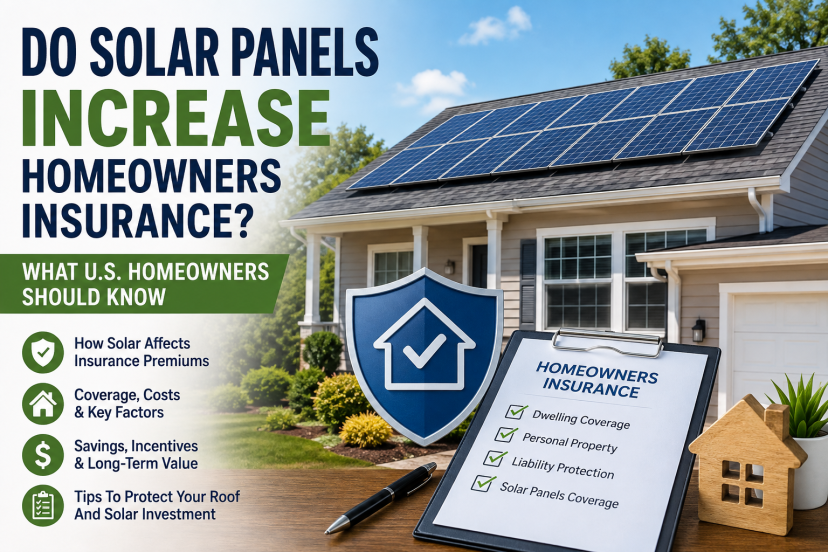
Installing solar can lower your electricity bills and make your home more energy independent, but do solar panels increase homeowners insurance? For many U.S. homeowners, this is an important question to answer before signing a solar installation contract.
The good news is that rooftop solar panels are often treated as part of the home and may be covered by a standard homeowners insurance policy. However, adding a solar energy system can increase your home’s replacement value, which may mean you need a higher dwelling coverage limit. Depending on your insurer, location, system type, roof condition, and local weather risks, that could result in a modest premium increase.
Understanding your coverage before installation can prevent expensive surprises later. Here’s what solar homeowners should know about insurance costs, roof protection, system ownership, warranties, tax incentives, and long-term savings.
☀️ Quick Answer: Do Solar Panels Increase Homeowners Insurance?
Do solar panels increase homeowners insurance? They can, but not always. Rooftop solar panels are commonly considered a permanent part of the home, so your existing homeowners policy may cover them. However, because solar increases the cost of rebuilding or repairing your property, your insurer may recommend increasing your dwelling coverage. That can raise your premium. Coverage rules vary by insurer, state, system ownership, and installation type, so contact your insurance company before installation.
Key Takeaways
Most likely cause: If your insurance premium increases after adding solar, it is usually because the system raises your home’s insured replacement cost or changes the insurer’s risk assessment.
Usually serious? No. A modest insurance adjustment is generally small compared with the total cost and potential long-term energy savings of a properly designed solar system.
First thing to check: Ask your insurance company whether rooftop panels are covered under your current dwelling coverage and whether your coverage limit must be increased.
Best solution: Before installation, compare the solar proposal with your homeowners policy and confirm coverage in writing. When asking do solar panels increase homeowners insurance?, also ask about deductibles, exclusions, wind and hail coverage, and detached solar structures.
🏠 How Solar Panels Affect Homeowners Insurance
A rooftop solar array is more than an appliance sitting on your property. Once permanently attached to your roof, it generally becomes part of the structure of your home.
That distinction matters for insurance.
Many homeowners policies cover permanently installed rooftop solar panels under dwelling coverage. If the panels are damaged by a covered event—such as certain fires, storms, or falling objects—the policy may help pay for repairs or replacement, subject to its deductible, limits, and exclusions.
However, installing a $20,000 or $30,000 solar system doesn’t automatically mean your annual insurance premium will increase dramatically.
The insurer is primarily concerned with the cost of restoring the property after a covered loss.
For example, if rebuilding your home without solar would cost $400,000 but replacing the home and its solar equipment would cost more, the insurer may recommend increasing your dwelling coverage.
That higher limit can sometimes mean a higher premium.
💵 How Much Can Solar Panels Increase Homeowners Insurance?
There is no standard national price increase for solar homeowners insurance.
The effect depends on several factors:
- System Value: Larger and more expensive solar arrays may increase replacement costs more than small systems.
- Location: Homes exposed to hurricanes, hail, wildfires, or severe storms may face different insurance considerations.
- Roof Type: Asphalt shingles, metal roofing, tile, and other roofing materials have different repair and replacement costs.
- Installation Method: Roof-mounted and ground-mounted systems may be insured differently.
- Coverage Limits: Increasing dwelling or other structures coverage can affect premiums.
- Deductibles: Windstorm, hurricane, or hail deductibles may differ from the standard policy deductible.
- Insurance Company: Each carrier has its own underwriting requirements.
Because these variables differ significantly, homeowners should get an actual insurance quote rather than relying on a national average.
Solar Insurance Cost Comparison
| Situation | Possible Insurance Impact |
|---|---|
| Small Rooftop Solar System | Little or no premium change |
| Large Rooftop Array | Possible dwelling coverage increase |
| Ground-Mounted Solar | May require other structures coverage |
| Solar Carport | Coverage may depend on structure classification |
| High Storm-Risk Location | Potentially higher insurance costs or deductibles |
| Solar Battery System | May require additional underwriting review |
Always confirm these details with your insurer because policy definitions and coverage vary.
🔨 Does Your Roof Matter When Insuring Solar Panels?
Absolutely.
Your roof is the foundation of a rooftop solar installation, so its age, material, condition, and expected lifespan should be evaluated before panels are installed.
Putting a new solar array on a roof that may need replacement in five years can create unnecessary costs.

To replace the roof later, contractors may need to remove the panels, complete the roofing work, and reinstall the solar array. Those removal and reinstallation costs are not necessarily covered by homeowners insurance when roof replacement is simply due to age or normal wear.
Before going solar, consider having a qualified roofing professional inspect:
- Shingle or roofing material condition.
- Flashing around vents and penetrations.
- Signs of previous roof leaks.
- Structural condition of the roof deck.
- Estimated remaining roof lifespan.
If your roof is approaching the end of its useful life, replacing it before solar installation may be the more economical long-term decision.
🛡️ What Solar Damage Does Homeowners Insurance Cover?
Coverage depends entirely on your policy, but permanently installed solar panels may generally receive protection similar to other parts of your home when damage results from a covered peril.
Depending on the policy, covered events might include fire, certain wind damage, falling objects, or other specified losses.
However, homeowners insurance generally isn’t a substitute for solar equipment warranties or routine maintenance.
Insurance Vs. Solar Warranty
| Protection | Homeowners Insurance | Solar Warranty |
|---|---|---|
| Fire Damage | Potentially | Usually No |
| Storm Damage | Potentially | Usually No |
| Manufacturing Defect | Usually No | Potentially |
| Inverter Defect | Usually No | Potentially |
| Panel Performance Decline | No | May Be Covered |
| Normal Wear | No | Usually No |
| Poor Installation | Usually Limited/Excluded | Installer Warranty May Apply |
This is why homeowners should consider insurance and solar warranties as separate layers of protection.
A strong solar project may include a manufacturer’s product warranty, panel performance warranty, inverter warranty, and installer workmanship warranty in addition to homeowners insurance.
⚡ Does Solar Ownership Affect Insurance Coverage?
It can.
If you purchase your solar panels, the system belongs to you and is generally considered an improvement to your property.
Leased systems and power purchase agreements can be more complicated because a solar company or third party may own the equipment installed on your roof.
The agreement may specify who is responsible for insuring the equipment, repairing damage, and handling removal or reinstallation after roof work.
Before signing a lease or power purchase agreement, find out:
- Who owns the equipment?
- Who insures the panels?
- Who pays if the roof is damaged?
- Who pays for panel removal during roof replacement?
- What happens if you sell your home?
- What happens if the solar company stops operating?
Don’t assume your homeowners insurance automatically handles every situation involving third-party equipment.
🌪️ Solar Panels, Hail, Hurricanes And Severe Weather
Location can significantly influence the answer to do solar panels increase homeowners insurance?
Homeowners in Florida, Texas, Colorado, California, and other areas exposed to hurricanes, hail, wildfires, or severe weather may face additional underwriting considerations.
Modern solar panels are designed to withstand outdoor conditions, but no rooftop equipment is indestructible.
Your insurer may want information about the mounting system, building permits, electrical inspection, panel specifications, and installation contractor.

In hurricane-prone regions, local building codes may also require solar mounting systems to meet specific wind-load requirements.
In hail-prone regions, homeowners should review both the panel manufacturer’s testing information and their insurance policy’s hail coverage.
A professionally engineered and code-compliant installation helps protect both the solar system and the roof beneath it.
💡 Will Solar Panels Still Save Money If Insurance Costs Increase?
Potentially, yes.
A small increase in homeowners insurance doesn’t necessarily eliminate the financial benefits of solar.
Consider the complete long-term calculation:
Annual electricity savings – additional insurance costs – maintenance costs = estimated annual net savings
Suppose solar reduces your electricity expenses by $1,500 per year while your homeowners insurance increases by $100. Ignoring other expenses, the insurance adjustment represents only a fraction of the energy savings.
Actual solar savings depend heavily on electricity rates, system production, financing costs, roof orientation, shading, incentives, and local net-metering or compensation rules.
Solar should therefore be evaluated as a complete home energy investment—not solely by the cost of the panels.

💰 Federal Solar Tax Credit And Other Incentives
U.S. homeowners considering solar should investigate available federal, state, utility, and local incentives before installation.
Federal tax incentives may substantially reduce the effective cost of qualifying residential clean-energy improvements. However, eligibility rules, percentages, deadlines, and qualifying expenses can change.
State and utility programs may also provide:
- Rebates.
- Property tax incentives.
- Sales tax exemptions.
- Battery storage incentives.
- Performance-based incentives.
- Special financing programs.
Check current federal requirements and your state’s energy office or utility before making financial decisions.
One important distinction: a tax credit can reduce qualifying tax liability, but it does not automatically reduce your homeowners insurance premium.
🔋 What About Solar Batteries?
Battery storage can make a solar home more resilient by storing electricity for use when solar production is low and, with properly configured equipment, potentially providing backup power during outages.
However, batteries add another valuable piece of equipment to the property.
Your insurance company may want to know:
- Battery type.
- Storage capacity.
- Installation location.
- Whether it is indoors or outdoors.
- Whether permits were obtained.
- Whether installation meets applicable electrical and fire codes.
Before installing a home battery, tell your insurer and ask whether it changes your coverage requirements.
🧰 Installation Tips That Can Protect Your Roof And Solar Investment
Choosing the cheapest solar proposal isn’t always the best long-term strategy. Installation quality can affect roof performance, system reliability, warranty protection, and potentially future insurance claims.
Look for a properly licensed and insured contractor familiar with local building codes.
Before installation:

- Inspect The Roof: Repair damaged roofing before mounting panels.
- Verify Licensing: Confirm contractor licensing requirements in your state.
- Ask About Insurance: Request proof of contractor liability and workers’ compensation coverage where applicable.
- Review Roof Penetrations: Understand how mounting points will be flashed and waterproofed.
- Check Warranties: Read the equipment and workmanship warranty terms.
- Confirm Permits: Make sure required building and electrical permits are obtained.
- Contact Your Insurer: Confirm how the completed solar system will be covered.
Keep your contracts, receipts, permits, equipment specifications, photographs, and warranty documents after installation. These records may be useful if you later file an insurance or warranty claim.
📈 Can Solar Panels Increase Home Value?
Solar panels may make a property more attractive to buyers who value lower energy expenses, but the effect varies considerably by market.
System ownership is especially important.
A homeowner-owned solar array may be easier to incorporate into a home sale than a leased system that requires contract transfer or other obligations.
Higher property value and higher insured replacement cost are also different concepts. Your insurance company generally focuses on what it would cost to repair or rebuild insured property—not simply what buyers might pay for your home.
That’s another reason to tell your insurer when you make a major improvement such as solar installation.
🔧 Solar Maintenance And Long-Term Roof Protection
Solar panels generally have few moving parts, but the system and roof should still be monitored over time.
Homeowners should periodically look for obvious panel damage, loose-looking components, debris accumulation, roof leaks, pest activity, or unusual changes in system production.
Avoid climbing onto a solar-equipped roof unless you’re qualified to do so. Walking near panels can create fall hazards and may damage roofing materials.
Professional inspections may be appropriate after major storms or when you notice:
- Sudden production losses.
- Visible panel damage.
- Water stains inside the home.
- Damaged roof flashing.
- Loose mounting components.
- Electrical or inverter warnings.
Catching problems early may prevent a relatively small issue from becoming an expensive repair.
👷 When To Call A Professional
Contact a certified solar installer, licensed electrician, qualified roofing contractor, or your insurance company if you notice roof leaks, damaged panels, electrical problems, storm damage, or unexplained reductions in solar production.
You should also speak with both your insurer and solar installer before installing panels. Confirm roof condition, mounting requirements, permits, warranties, system value, dwelling coverage, deductibles, and any insurance documentation requirements before work begins.
❓ Frequently Asked Questions
1. Do Solar Panels Increase Homeowners Insurance Premiums?
They can. Some insurers may increase premiums if the solar system raises the home’s insured replacement cost or requires higher dwelling coverage. Other homeowners may see little or no premium change.
2. Are Solar Panels Covered By Standard Homeowners Insurance?
Permanently attached rooftop solar panels may be covered as part of the dwelling under many homeowners policies. Coverage varies, so confirm this directly with your insurer before installation.
3. Do I Need To Tell My Insurance Company About Solar Panels?
Yes. Informing your insurer before installation allows the company to determine whether your existing coverage is sufficient and whether the solar system creates additional requirements.
4. Does Homeowners Insurance Cover Hail Damage To Solar Panels?
It may if hail is a covered peril under your policy. However, deductibles, exclusions, and special wind or hail provisions can apply. Review your specific policy.
5. Are Ground-Mounted Solar Panels Covered By Homeowners Insurance?
Possibly, but they may be treated differently from roof-mounted panels. Ground-mounted arrays could fall under other structures coverage or require additional coverage depending on the insurer.
6. Does Homeowners Insurance Cover Solar Panel Roof Leaks?
It depends on what caused the leak. Sudden damage from a covered event may be treated differently from leaks caused by poor installation, defective workmanship, deterioration, or lack of maintenance. Installer workmanship warranties can therefore be important.
7. Does Adding A Solar Battery Increase Homeowners Insurance?
It may. Battery storage increases the equipment value at your home and can introduce additional underwriting requirements. Ask your insurer about coverage, installation standards, and whether your premium or coverage limits will change.
🌞 Final Thoughts: Check Insurance Before Going Solar
So, do solar panels increase homeowners insurance? Sometimes—but the increase may be modest or nonexistent depending on your insurer, system, home, and location.
The bigger priority is making sure your solar investment is properly protected.
Before installing solar, contact your insurance company, have an aging roof inspected, compare qualified solar contractors, review warranties, and verify current incentives. A little preparation can help you avoid insurance gaps, unnecessary roof work, and unexpected costs later.
If your roof may need replacement soon, start with a professional roof inspection or roofing quote. If the roof is ready for solar, compare several solar proposals based on system production, equipment quality, warranties, financing, and total long-term savings—not price alone.
Disclaimer: This article is for general informational purposes only and is not insurance, tax, financial, roofing, or legal advice. Insurance coverage, pricing, solar incentives, tax credits, building codes, and installation requirements vary by location and may change. Always consult your insurance provider and appropriately licensed solar, roofing, tax, or other professionals before making decisions.
 Explore more:
- Eco-Friendly Solar Roofing Options
- Can You Install Solar Panels On Any Roof?
- Can I Add More Solar Panels Later?