Small Home Solar Setup: What Most Homeowners Get Wrong In 2026
☀️ Why So Many Small Homeowners Feel Confused About Solar
Solar sounds simple at first.
You install panels, lower your electric bill, and enjoy “free energy” for years.
But many small homeowners quickly discover the reality is more complicated.
Some install systems that are too large. Others choose cheap equipment that performs poorly. Some homeowners underestimate shading problems or overestimate how much money they will save.
And in many cases, small homes have unique challenges that larger homes do not.
Limited roof space, lower energy usage, roof angles, battery costs, and future electricity needs all play a major role.
The good news?
Most expensive mistakes are avoidable when homeowners understand how small-home solar actually works in 2026.
⚡ Quick Answer: What Do Most Homeowners Get Wrong About Small Home Solar Setups?
The biggest mistake is assuming solar systems work the same way for every home.
Small homes require a different approach.
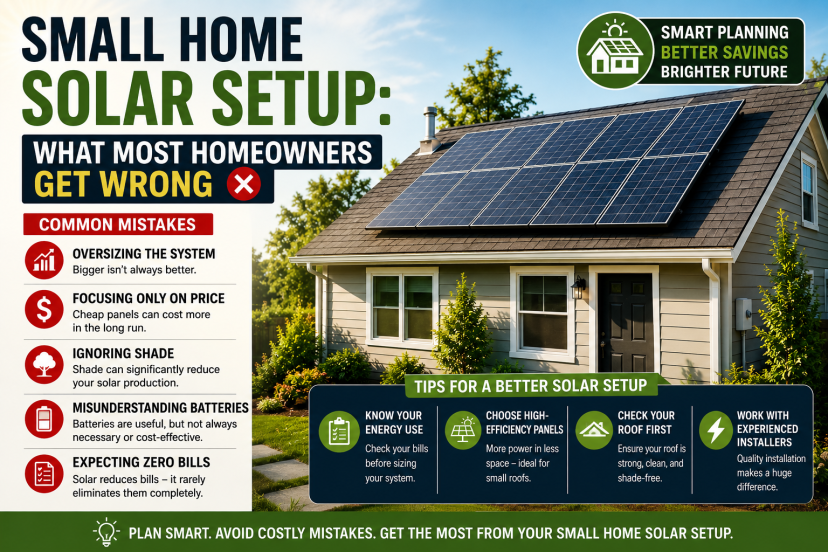
Many homeowners get these things wrong:
- Buying oversized systems
- Choosing cheap, low-efficiency panels
- Ignoring roof shading
- Forgetting the roof condition
- Misunderstanding battery costs
- Expecting zero electric bills
- Focusing only on the upfront price
For small homes, efficiency and smart planning usually matter far more than simply adding more panels.
🔍 Why Small Home Solar Setups Require Smarter Planning
Limited Roof Space Changes Everything
Large homes often have plenty of roof space to work with.
Small homes do not.
That means:
- Panel efficiency matters more
- Roof layout becomes critical
- Every panel placement counts
- Shade has a larger impact
A poorly designed system on a small roof can significantly reduce energy production.
Smaller Energy Usage Creates Different Priorities
Small homeowners often use less electricity overall.
This changes the financial equation.
Sometimes a smaller, carefully optimized system delivers better value than a large, expensive setup.
Technology Is Improving Fast
In 2026, solar panels will be much more efficient than older systems.
Modern systems can generate more power using fewer panels.
This is great news for:
- Small homes
- Tiny homes
- Cabins
- Compact suburban properties
But homeowners still need the right equipment and layout.
🏡 Real-Life Examples Of Small Home Solar Mistakes
The Oversized System Problem
Some homeowners install systems far larger than they actually need.
Why?
Because larger systems are often promoted as “better.”
But for small homes, oversized systems may:
- Increase financing costs
- Extend payback periods
- Waste roof space
- Add unnecessary complexity
Bigger is not always smarter.
Cheap Panels On A Small Roof
A homeowner with limited roof space chooses inexpensive, low-efficiency panels.
The result?
The system cannot generate enough electricity to meaningfully reduce utility bills.
Sometimes, premium panels are worth the higher upfront cost because they maximize production per square foot.
Ignoring Shade Until After Installation
Trees and nearby buildings create far more problems than many homeowners expect.
Even partial shading can reduce output dramatically on certain systems.
This is especially important for small roofs where every panel matters.
Battery Expectations That Do Not Match Reality
Many homeowners believe batteries will make them fully energy independent immediately.

But batteries remain expensive in 2026.
For some small homeowners, grid-tied systems without batteries may provide better financial value initially.
🛠️ Practical Tips For A Better Small Home Solar Setup
Start With Your Energy Usage
Before buying solar:
- Review 12 months of electric bills
- Identify seasonal spikes
- Understand daily consumption patterns
This helps prevent overspending on unnecessary system size.
Prioritize High-Efficiency Panels
For limited roof space, efficiency matters.
High-efficiency panels often:
- Generate more power
- Use fewer panels
- Fit compact roofs better
- Improve long-term savings
Monocrystalline panels are usually the preferred option for small homes.
Check Your Roof Condition First
Installing solar on an aging roof creates future headaches.
Before installation:
- Inspect shingles
- Check the roof age
- Identify structural issues
- Evaluate drainage
Removing and reinstalling panels later can become expensive.

Consider Microinverters
Microinverters allow panels to operate independently.
Benefits include:
- Better shade performance
- Easier monitoring
- Improved flexibility
- More reliable energy production
This can be especially useful for roofs with uneven sunlight.
Improve Home Efficiency Before Installing Solar
Sometimes the best “solar upgrade” happens inside the home first.
Energy-saving upgrades may include:
- LED lighting
- Better insulation
- Smart thermostats
- Efficient appliances
- Window sealing
Reducing energy waste can lower the size and cost of the solar system needed.
🚫 Common Small Home Solar Setup Mistakes
Focusing Only on the Lowest Price
Cheap systems often use:
- Lower-efficiency panels
- Shorter warranties
- Lower-quality inverters
- Less reliable installation
For small roofs, quality matters more because space is limited.
Forgetting Future Electricity Needs
Future changes may increase energy usage:
- Electric vehicles
- Home office equipment
- Heat pumps
- Battery charging
- Family growth
Plan for the next 5–10 years — not just current bills.
Expecting Solar To Eliminate Bills Completely
Many homeowners still pay:
- Utility connection fees
- Seasonal electricity costs
- Nighttime energy usage
Solar reduces bills — but rarely makes them disappear entirely.
Installing Solar Without Comparing Quotes
Solar pricing varies heavily between installers.
Always compare:
- Equipment brands
- Efficiency ratings
- Financing terms
- Warranty coverage
- Installer reputation
Ignoring Roof Orientation
South-facing roofs usually perform best in the U.S.
But east- and west-facing roofs can still work depending on:
- Local climate
- Energy usage habits
- Electricity pricing
Roof direction affects long-term production more than many homeowners realize.
❓ FAQ: Small Home Solar Setup Questions
Is solar worth it for small homes in 2026?
For many homeowners, yes.
Especially if electricity costs are high and the roof gets good sunlight.
What type of solar panel is best for small homes?
High-efficiency monocrystalline panels are usually best for limited roof space.
How many solar panels does a small home need?
Most small homes use between 6 and 14 panels, depending on energy usage and climate.
Are batteries necessary for small home solar?
Not always.
Many homeowners start with grid-tied systems and add batteries later if needed.
What is the biggest mistake homeowners make?
Oversizing the system or choosing low-quality panels for a limited roof area.
Can solar work on partially shaded roofs?
Yes, especially when using microinverters or power optimizers.
🌱 Final Thoughts On Small Home Solar Setups
Small home solar setups can absolutely work well in 2026.
But smaller homes require smarter decisions.
The best systems are usually:
- Efficient
- Properly sized
- Carefully planned
- Built around real energy usage
The goal is not building the biggest solar setup possible.
The goal is to maximize long-term value from limited roof space.
When homeowners focus on efficiency, roof condition, quality equipment, and realistic expectations, small-home solar can become one of the smartest upgrades they make for lower utility bills and greater energy independence.
Disclaimer: This article is for informational purposes only and should not be considered financial, roofing, or electrical advice. Always consult qualified solar and roofing professionals before making installation decisions.
 Explore more:
- Tesla Solar Roof Vs Traditional Solar Panels
- Is A Solar Roof Worth It For Small Homes In 2026?
- Solar For Small Homes