Can Small Homes Use Solar In Snowy States? What Homeowners Need To Know
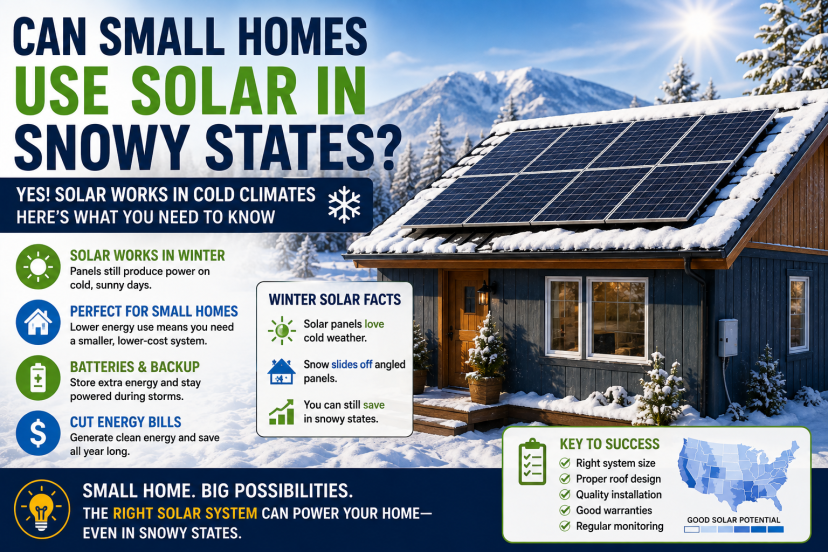
If you own a smaller home in Minnesota, Michigan, Colorado, Maine, Vermont, or another cold-weather state, you may wonder whether your climate makes solar a poor investment. Can small homes use solar in snowy states? Absolutely. Solar panels need sunlight—not hot weather—to generate electricity, and modern photovoltaic systems can work effectively in cold climates.
Snow does create challenges. Heavy accumulation can temporarily cover panels, shorter winter days reduce available sunlight, and your roof must safely support both solar equipment and local snow loads. But a small house can also have an advantage: lower overall electricity consumption may mean you need a smaller, less expensive solar array.
The key is designing the system for your specific home and climate. Roof orientation, shade, snow patterns, annual electricity use, panel efficiency, utility policies, and battery needs all matter when determining whether cold-climate solar makes financial sense.
❄️ Quick Answer: Can Small Homes Use Solar In Snowy States?
Can small homes use solar in snowy states? Yes. Solar panels continue generating electricity in cold weather and can perform efficiently at low temperatures when sunlight reaches the cells.
Snow covering the panels can temporarily reduce or stop production, but tilted arrays may shed snow as conditions improve. For small homes, the best approach is to size the system according to annual electricity consumption, available roof space, local solar resources, snow loads, and utility policies.
Key Takeaways
- Most likely cause: Homeowners asking can small homes use solar in snowy states are usually concerned that cold temperatures, limited roof space, and snow cover will prevent adequate electricity production.
- Usually serious? No. Cold temperatures alone do not prevent solar panels from working, although accumulated snow can temporarily reduce output.
- First thing to check: Review your annual electricity consumption, usable roof area, roof condition, orientation, shade, and local snow-load requirements.
- Best solution: Use a properly sized system with quality panels and mounting equipment designed for your local climate and have the roof evaluated before installation.
☀️ Solar Panels Don’t Need Hot Weather
One of the biggest misconceptions about solar energy is that panels work best when the weather is hot.
Solar photovoltaic cells convert sunlight into electricity. They do not need summer temperatures to operate.
In fact, high temperatures can temporarily reduce the power output of photovoltaic modules. Cold, sunny weather can provide excellent operating conditions when panels are clear of snow.
This is why solar installations can be found throughout northern U.S. states.
The more important question is how much solar radiation reaches your property throughout the year.
Annual solar production depends on factors including:
- Latitude
- Cloud Cover
- Roof Orientation
- Roof Pitch
- Tree Shade
- Snow Cover
- Panel Efficiency
- System Design
A professional solar estimate should use local weather and solar-resource data rather than simply assuming that a snowy state has poor solar potential.
🌨️ What Happens When Snow Covers Solar Panels?
If you’re researching can small homes use solar in snowy states, snow cover is probably your biggest concern.
A light dusting may allow some light to reach the panels, but thick snow can significantly reduce or temporarily stop solar production.
That sounds alarming, but it needs to be viewed in the context of annual energy production.
A system can lose production for several snowy days and still generate substantial electricity during the rest of the year.
Solar panels also have smooth glass surfaces, and many roof-mounted arrays are installed at an angle. Under the right conditions, snow can slide away as sunlight warms the panel surface.
However, homeowners should never assume that every array will quickly clear itself. Roof pitch, temperature, snow type, ice, shading, and installation design all influence snow shedding.
🏠 Is A Small Roof Big Enough For Solar?
A small home naturally has less roof area, but it may also use much less electricity.
That can work in your favor.
Imagine a compact, well-insulated home using 5,000 kWh of electricity annually compared with a large all-electric home using 15,000 kWh or more. The smaller house may require considerably less solar capacity to offset a meaningful share of its electricity use.
Modern residential solar panels can commonly provide several hundred watts of rated power per panel.
A hypothetical system using 400-watt panels would have approximately:
| Number Of Panels | Rated System Size |
|---|---|
| 5 | 2.0 kW |
| 8 | 3.2 kW |
| 10 | 4.0 kW |
| 12 | 4.8 kW |
| 15 | 6.0 kW |
Actual electricity production varies by location, panel orientation, weather, shade, and system losses.
The goal is not to fit as many panels as possible. It is to create the most productive system your usable roof area and budget can support.
📐 Roof Pitch Matters In Snowy States
Roof design becomes especially important in snow country.
A steeper solar array may shed snow more easily than a nearly flat one, but the ideal panel angle also depends on structural, energy-production, wind, aesthetic, and code considerations.
Your installer must account for local requirements.
Snow Loads Need Professional Evaluation
Snow is heavy.
Your roof already needs to support expected snow loads, and solar equipment adds additional weight.
A qualified installer should determine whether the roof structure is appropriate for the planned system and whether engineering review is required.
Important considerations include:
- Local design snow loads.
- Solar panel and racking weight.
- Roof framing.
- Roofing condition.
- Mounting attachment locations.
- Wind requirements.
- Snow accumulation patterns.
This is particularly important for older small homes, cabins, accessory dwelling units, and tiny homes that may not have been designed with rooftop solar in mind.
🧊 Can Solar Panels Handle Heavy Snow?
Quality solar modules are designed and tested for mechanical loads, but ratings vary.
Manufacturers publish specifications for maximum static loads, often including separate front-side and rear-side ratings.
When comparing equipment for a snowy climate, ask about:

- Module Snow-Load Rating
- Mounting-System Load Rating
- Wind Rating
- Product Warranty
- Performance Warranty
- Cold-Weather Specifications
The entire installation matters.
A strong solar panel attached to an inadequate mounting system or weak roof does not create a resilient solar installation.
Choose an installer familiar with local building codes and winter conditions.
🧹 Should You Remove Snow From Solar Panels?
Usually, homeowners should not climb onto a snowy or icy roof to clear solar panels.
The safety risk is far greater than the value of recovering a few hours or days of electricity production.
Improper snow removal can also scratch panel glass, damage wiring, loosen equipment, or potentially affect warranty coverage.
Avoid:
- Metal shovels.
- Hard scraping tools.
- Hot water on frozen panels.
- Walking on solar modules.
- Climbing onto icy roofs.
If snow accumulation creates a genuine system, roof, or safety concern, contact a qualified professional.
For most grid-connected homes, temporarily buying more electricity from the utility while panels are snow-covered is safer than trying to clear a dangerous roof yourself.
⚡ Grid-Tied Vs. Off-Grid Solar In Snowy States
Whether the home is connected to the electrical grid changes the winter solar equation significantly.

| Feature | Grid-Tied Small Home | Off-Grid Small Home |
|---|---|---|
| Utility Backup | Yes | No |
| Battery Required | Usually No | Generally Yes |
| Winter Solar Shortfall | Grid Can Supplement | Must Be Planned For |
| System Complexity | Lower | Higher |
| Backup Generator | Optional | Often Valuable |
| Battery Capacity | Optional | Critical |
Grid-Tied Homes
A grid-connected small home can draw electricity from the utility during nights, storms, or periods when panels are covered by snow.
This makes seasonal variation much easier to manage.
Off-Grid Homes
An off-grid cabin or tiny home in a snowy state requires much more careful planning.
Short winter days combined with snowstorms and cloudy weather can create extended periods of low solar production.
Off-grid designs may require:
- More solar capacity.
- Larger battery storage.
- Highly efficient appliances.
- Reduced winter energy consumption.
- A backup generator or secondary energy source.
Sizing an off-grid system based only on sunny summer conditions can leave the home severely underpowered in winter.
🔋 Are Solar Batteries Worth It In Cold Climates?
Battery storage can increase home energy resilience, but it is not automatically necessary for every solar installation.
A battery may make sense if you experience frequent winter power outages, want backup electricity, have time-of-use utility rates, or want to use more of your solar electricity after sunset.
However, batteries add substantial cost and introduce temperature considerations.
Many lithium-based batteries have specific operating and charging temperature limits. Manufacturers may require indoor installation, conditioned spaces, integrated thermal management, or other protections in very cold climates.
Never install a battery in an unheated outdoor location unless the equipment is specifically rated and installed for those conditions.
💰 Does Solar Save Money In Snowy States?
It can.
When asking can small homes use solar in snowy states, focus on annual economics rather than winter production alone.
Solar savings depend on:
System Cost – Available Incentives + Electricity Savings Over Time
The biggest variables include:
- Your electricity rate.
- Annual solar production.
- System cost.
- Financing expenses.
- Utility export compensation.
- Maintenance and repair costs.
- Available state or local incentives.
- How long you remain in the home.
Some northern states have relatively high electricity rates, which can improve the value of every kilowatt-hour generated at home.
Ask for a production estimate that accounts for your exact location, roof, shade, and local climate.
💵 What Solar Incentives Are Available In 2026?
U.S. homeowners need to be careful with older solar information online.
The federal Residential Clean Energy Credit, which previously provided a 30% credit for qualifying homeowner solar expenditures, ended for expenditures after December 31, 2025.
Therefore, homeowners considering a new residential installation in 2026 should not automatically include the former 30% homeowner federal solar tax credit in their calculations.
However, depending on your state and utility, other programs may still include:
- State Solar Rebates
- Utility Incentives
- Property-Tax Exemptions
- Sales-Tax Exemptions
- Renewable Energy Certificates
- Local Energy Programs
Some snowy states have historically supported strong solar markets through state-level programs and favorable electricity policies.
Always verify current eligibility before making a purchasing decision.
🛡️ Check Your Roof Before Installing Solar
Solar panels may produce electricity for 25 to 30 years or longer, so installing them over an aging roof can create future problems.
This matters even more in snowy climates, where roofing materials experience repeated freeze-thaw cycles, snow, ice, wind, and moisture.
Before solar installation, check for:
- Aging shingles.
- Previous leaks.
- Damaged flashing.
- Sagging areas.
- Ice-dam history.
- Inadequate ventilation.
- Structural concerns.
If your roof is nearing the end of its useful life, replacing it before installing solar may save you from paying to remove and reinstall panels later.
🏔️ Small Home Solar: Snowy State Vs. Warm State
Cold climates are not automatically worse for solar.
| Factor | Snowy Climate | Warm Climate |
|---|---|---|
| Cold Panel Efficiency | Potential Advantage | Less Relevant |
| Snow Cover | Temporary Production Loss | Rare |
| Winter Daylight | Often Lower | Often Higher |
| Summer Production | Can Be Strong | Often Strong |
| Snow-Load Design | Important | Usually Less Important |
| Extreme Heat | Lower In Many Areas | Can Reduce Output |
| Annual Savings | Location-Specific | Location-Specific |
A small home in Colorado with excellent sun exposure could potentially outperform a shaded home in a warmer climate.
Location alone does not determine whether solar is worthwhile.
👷 When To Call A Professional
Contact a qualified solar installer if you need a location-specific production estimate, structural assessment, electrical evaluation, snow-load calculation, battery design, or roof-layout plan.
Call a licensed roofing professional if your home has an older roof, previous leaks, sagging, ice-dam damage, deteriorated shingles, or structural concerns.
For snowy climates, choose professionals familiar with local snow, wind, roofing, permitting, and building-code requirements rather than relying solely on national averages.
❓ Frequently Asked Questions
Do Solar Panels Work When It Is Snowing?
Yes, panels can still generate some electricity during light snow if sunlight reaches the solar cells. However, heavy accumulation covering the panel surface can significantly reduce or temporarily stop production.
Do Solar Panels Work In Freezing Temperatures?
Yes. Photovoltaic panels generate electricity from sunlight rather than heat. Cold temperatures do not prevent them from working, and solar cells can operate efficiently in cold, sunny conditions.
Does Snow Need To Be Removed From Solar Panels?
Usually not by the homeowner. Snow may naturally slide or melt from tilted panels. Climbing onto an icy roof is dangerous, and improper tools can damage the system.
Are Solar Panels Worth It In Northern States?
They can be. Electricity prices, annual sunlight, roof orientation, system costs, incentives, shade, and utility policies matter more than cold weather alone.
Can Heavy Snow Break Solar Panels?
Extremely heavy loads can damage improperly designed equipment or roofing. Quality modules and mounting systems have specified mechanical load ratings, and installations should be engineered to meet applicable local snow-load requirements.
Do I Need Solar Batteries In A Snowy State?
Not necessarily. Grid-connected systems can use utility electricity when solar production is low. Batteries become more attractive for backup power, frequent outages, off-grid living, or certain utility-rate structures.
Can A Small Roof Produce Enough Solar Electricity?
Potentially. Small homes often consume less electricity, and modern high-output panels can produce substantial power from limited roof space. A site-specific solar assessment can determine how much usable capacity your roof can support.
🌞 Conclusion: Can Small Homes Use Solar In Snowy States?
So, can small homes use solar in snowy states? Yes—and cold weather itself should not stop you from exploring solar.
Modern photovoltaic panels can generate electricity efficiently in cold temperatures. Snow cover may temporarily reduce production, but system performance should be evaluated across the entire year rather than during a few winter storms.
For a small home, efficiency is your biggest advantage. Good insulation, air sealing, efficient heating and cooling, LED lighting, and energy-efficient appliances can reduce electricity demand and make a smaller solar array more practical.
Before installing panels, have your roof evaluated for condition and local snow loads. Then request solar quotes based on your actual electricity bills, roof orientation, shade, local weather data, and current utility policies.
A properly designed cold-climate solar system can help a small home become more efficient, resilient, and less dependent on rising electricity costs—even when snow is part of your winter.
Disclaimer: Solar production, system costs, snow-load requirements, warranties, incentives, utility policies, and savings vary by location and property. Always verify current programs and consult qualified solar, electrical, structural, and roofing professionals before installation.
 Explore more:
- What Is The Most Energy-Efficient Roofing?
- What Is The Best Solar Inverter For Small Home?
- What Should I Know Before Buying Solar Panels?