How Long Do Solar Panels Last? Lifespan, Warranties And What Homeowners Should Expect
Installing solar is a long-term investment, so one question matters almost as much as the initial price: How long do solar panels last? After all, U.S. homeowners want a system that can lower electricity bills for decades—not equipment that needs replacing after a few years.
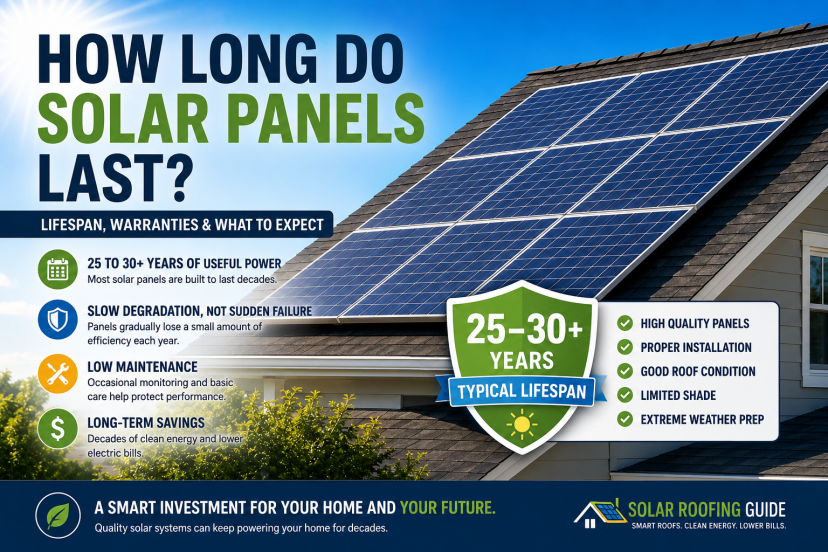
The encouraging news is that modern residential solar panels are built for long-term outdoor exposure. A well-designed system can continue generating useful electricity for 25 to 30 years or longer. Panels do not usually stop working when they reach a certain age. Instead, their electricity production gradually declines over time.
Your actual solar panel lifespan depends on panel quality, installation, climate, roof condition, maintenance, and exposure to extreme weather. Understanding these factors can help you choose better equipment, protect your roof, evaluate warranties, and estimate the true long-term value of going solar.
☀️ Quick Answer: How Long Do Solar Panels Last?
How long do solar panels last? Most quality residential solar panels are designed to provide useful electricity for about 25 to 30 years or longer. They normally do not suddenly fail at the end of that period. Instead, solar output slowly decreases through a process called degradation.
Many modern manufacturers provide performance warranties lasting 25 years or more, while some panels can remain productive well beyond their warranty period.
Key Takeaways
- Most likely cause: When homeowners ask how long do solar panels last, they are usually concerned about whether gradual degradation will reduce their long-term energy savings.
- Usually serious? No. Gradual solar panel degradation is normal and generally occurs slowly over many years.
- First thing to check: Review the manufacturer’s product and performance warranties, including the guaranteed output near the end of the warranty period.
- Best solution: Choose quality panels, use an experienced installer, make sure your roof is in good condition, and monitor system production over time.
🔋 What Is The Average Solar Panel Lifespan?
The commonly cited solar panel lifespan is around 25 to 30 years, but that number can be misleading.
Twenty-five years is not an expiration date.
Solar panels can continue producing electricity after 25 or 30 years if they remain physically and electrically sound. The important difference is that an older panel may produce less electricity than it did when new.
The U.S. Department of Energy notes that solar modules generally lose a small amount of performance each year. Research cited by the National Renewable Energy Laboratory has historically found median degradation rates around 0.5% per year for many photovoltaic systems, although actual rates vary by technology, climate, manufacturer, and system conditions.
At a hypothetical degradation rate of 0.5% per year, a panel would still produce roughly 88% of its original output after 25 years.
That slow decline is one reason solar can be considered a long-term home energy investment.
📉 Why Do Solar Panels Lose Efficiency Over Time?
Solar panels spend decades exposed to sunlight, heat, cold, rain, snow, humidity, wind, and temperature changes.
Over time, these stresses can contribute to gradual degradation.
Factors that may influence how long solar panels last include:
- Heat: High operating temperatures can accelerate certain forms of material degradation.
- Temperature Cycling: Repeated expansion and contraction can stress components over decades.
- UV Exposure: Long-term ultraviolet exposure can affect some module materials.
- Moisture: Poor sealing or physical damage may allow moisture to affect electrical components.
- Extreme Weather: Hail, hurricanes, heavy snow, and wind can physically damage equipment.
- Manufacturing Quality: Higher-quality materials and manufacturing processes may improve durability.
- Installation Quality: Incorrect mounting or wiring can create unnecessary system problems.
Solar panels are designed to tolerate outdoor conditions, but the environment still affects long-term performance.
🏠 Your Roof May Not Last As Long As Your Solar Panels
One of the most overlooked parts of solar planning is the relationship between solar panel lifespan and roof lifespan.
A solar array could remain on your house for several decades. Installing one on a roof that may need replacement in five years can create unnecessary expenses.
Consider this simplified comparison:
| Component | Typical Service Consideration |
|---|---|
| Solar Panels | Often 25–30+ years of useful production |
| Asphalt Shingles | Often roughly 15–30 years depending on product and conditions |
| Metal Roofing | Frequently several decades |
| Solar Inverter | May require replacement before the panels |
| Battery Storage | Typically has a shorter expected life than solar panels |
Actual lifespans vary substantially according to products, installation, weather, maintenance, and usage.
Should You Replace Your Roof Before Installing Solar?
If your roof is already approaching the end of its expected service life, replacing it before solar installation may be the smarter option.
Otherwise, replacing the roof later can require:
- Disconnecting the solar system.
- Removing the panels and mounting equipment.
- Replacing the roofing.
- Reinstalling the solar equipment.
- Reconnecting and testing the system.
That adds labor and expense.
Have an experienced roofer inspect an older or questionable roof before committing to solar.
🛡️ Solar Panel Warranties Explained
Warranties are especially important when evaluating how long solar panels last because different warranties cover different problems.
Product Warranty
The product warranty generally covers defects in materials or manufacturing.
Depending on the manufacturer and product line, coverage may last roughly 10 to 25 years or longer.
Read the exclusions carefully. Physical damage caused by improper installation, severe weather, unauthorized repairs, or other outside factors may not be covered.
Performance Warranty
A solar performance warranty addresses how much electricity-generating capacity the manufacturer guarantees the panel will retain over time.
For example, a manufacturer might guarantee a certain percentage of original rated output after 25 or 30 years.
The exact percentage and warranty structure vary by manufacturer.
Installation Or Workmanship Warranty
Your solar contractor may also offer a workmanship warranty covering installation-related issues.
This can be particularly important for roofing because solar mounting usually involves attachments to the roof structure.
Ask who is responsible if a roof leak develops around an attachment point and exactly how long that coverage lasts.
💰 Do Older Solar Panels Still Save Money?
Yes. Solar panels do not need to operate at 100% of their original output to provide value.
Suppose your system initially generates 10,000 kilowatt-hours of electricity per year. Years later, degradation might reduce annual output, but the system could still offset a meaningful amount of electricity you would otherwise purchase from the utility.
Long-term savings depend on several variables:
- Initial System Cost
- Solar Production
- Electricity Rates
- Panel Degradation
- Maintenance And Repair Costs
- Financing Costs
- Utility Export Compensation
- State And Local Incentives
- How Long You Own The Home
A longer-lasting system has more years to generate electricity and potentially recover its installation cost.
💵 What About Solar Incentives In The U.S.?
Homeowners should always calculate solar economics using incentives that are actually available when the system is installed.
An important change occurred at the end of 2025. The federal Residential Clean Energy Credit, which previously offered eligible homeowners a 30% tax credit for qualifying residential solar expenditures, ended for expenditures after December 31, 2025.
That means homeowners installing solar in 2026 should not automatically subtract a 30% federal homeowner solar tax credit when calculating their project cost.
However, depending on your location, other programs may still be available, including:
- State Solar Rebates
- Utility Incentives
- Property-Tax Exemptions
- Sales-Tax Exemptions
- Solar Renewable Energy Certificates
- Local Clean-Energy Programs
Because incentives change frequently, check current state, utility, and local programs before signing a contract.
🧹 Does Maintenance Help Solar Panels Last Longer?
Solar panels are relatively low-maintenance because they contain no moving mechanical parts.
However, low-maintenance does not mean no maintenance.
You can help protect your solar investment by following several simple practices.
1. Monitor Electricity Production
Most modern systems include monitoring software.

Watch for unexpected or sustained drops in production. A sudden decline may indicate an inverter problem, electrical fault, excessive shading, equipment damage, or another issue.
2. Keep Trees Under Control
Trees grow.
A roof that receives excellent sunlight today could experience significantly more shade 10 years from now. Strategic trimming may help maintain solar production while keeping trees healthy.
3. Inspect After Severe Weather
If your home experiences unusually large hail, strong winds, falling branches, or a major storm, have the system inspected if you notice visible damage or abnormal performance.
Avoid climbing onto the roof yourself.
4. Clean Panels Only When Necessary
Rain naturally removes much ordinary dirt from tilted solar panels.
Homes in dusty, dry, wildfire-prone, agricultural, or heavily polluted areas may experience more buildup. If cleaning is necessary, follow manufacturer recommendations or hire a qualified professional.
Improper cleaning can damage panels or create fall and electrical hazards.
⚡ Do Solar Inverters Last As Long As Solar Panels?
Not necessarily.
The inverter converts the direct-current electricity produced by your panels into alternating-current electricity used by your home.
Depending on the type and manufacturer, an inverter may need repair or replacement before the panels reach the end of their useful life.
String inverters and microinverters have different designs, warranties, costs, and replacement considerations.
When comparing solar quotes, don’t ask only how long do solar panels last. Also ask:
- How long is the inverter warranty?
- What happens if the inverter fails?
- Is labor included in replacement?
- Who handles warranty service?
- How much might an out-of-warranty replacement cost?
These expenses should be considered when estimating long-term solar savings.
🌦️ How Climate Affects Solar Panel Life
Solar panels are used successfully across the United States, from hot deserts to snowy northern climates.
However, environmental conditions can affect performance and durability.
Hot Climates
Solar panels love sunlight but do not necessarily love extreme heat. High panel temperatures can temporarily reduce electricity output and may contribute to long-term material stress.
Proper installation allows airflow beneath roof-mounted panels, helping heat escape.
Snowy Climates
Quality panels are designed for specific snow-load ratings. Snow can temporarily cover panels and reduce production, although tilted panels may shed snow as conditions change.
Your mounting system and roof structure must be appropriate for local snow loads.
Coastal Areas
Salt air can be corrosive. Homeowners near the ocean should look for equipment and mounting components designed for their environmental conditions.
Hail-Prone Regions
Solar modules undergo standardized durability testing, but exceptionally large hail can still cause damage.
Homeowners in hail-prone areas should discuss panel ratings, installation methods, warranties, and homeowners insurance with their installer.
🔄 When Should You Replace Old Solar Panels?
Age alone is not necessarily a reason to replace a functioning solar array.
Replacement may make sense when:
- Electricity production has fallen substantially.
- Several panels have failed.
- Repairs are becoming expensive.
- Replacement components are difficult to obtain.
- Roof replacement requires removing the array anyway.
- Newer equipment could provide significantly more production in limited roof space.
- The inverter or other major components need costly replacement.
If a 30-year-old system is still safely producing useful electricity, there may be little reason to remove it simply because of its age.
📊 Old Solar Panels Vs. New Solar Panels
Solar technology continues to improve, but newer does not automatically mean you should replace a working system.
| Factor | Older Panels | Modern Panels |
|---|---|---|
| Efficiency | Generally Lower | Generally Higher |
| Roof Space Needed | Potentially More | Potentially Less |
| Remaining Warranty | Limited Or Expired | New Warranty |
| Production | May Have Degraded | Full Initial Output |
| Replacement Cost | No Cost If Kept | New Investment Required |
| Useful Life | Depends On Condition | Potentially Decades |
If your current system still meets your energy goals, continuing to use it may provide greater value than replacing it prematurely.
👷 When To Call A Professional
Contact a certified or properly licensed solar professional if your monitoring system shows a significant unexplained production decline, you see damaged panels, electrical equipment reports faults, or the system needs to be removed for roof work.
Call a qualified roofing contractor if you notice leaks, damaged shingles, sagging, deteriorated flashing, or other roof problems beneath or near the solar array.
If you are considering a new installation, having an older roof evaluated before the panels go up can prevent costly removal and reinstallation later.
❓ Frequently Asked Questions About How Long Solar Panels Last
How Long Do Solar Panels Last On A House?
Most quality residential solar panels can provide useful electricity for 25 to 30 years or longer. Output gradually declines over time rather than stopping at a fixed age.
Do Solar Panels Stop Working After 25 Years?
Usually not. Twenty-five years often corresponds with a warranty period rather than a hard expiration date. Properly functioning panels may continue producing electricity for years afterward.
How Much Efficiency Do Solar Panels Lose Each Year?
Degradation varies by panel technology, manufacturer, environment, and operating conditions. Historically, studies have often found degradation around 0.5% annually for many systems, although individual systems can perform better or worse.
Can Solar Panels Last 40 Years?
Some panels may continue operating for 40 years, but electricity production will generally be lower than when they were new. Whether keeping them that long makes financial sense depends on their condition and output.
What Happens To Solar Panels When They Get Old?
Solar panels generally produce less electricity as they age. Eventually, homeowners may replace them because of reduced performance, damage, equipment failure, roof work, or the economics of upgrading.
How Often Do Solar Panels Need Maintenance?
There is no universal maintenance schedule for every installation. Homeowners should monitor production, visually check for obvious problems from a safe location, manage excessive shade, and arrange professional inspections when damage or performance problems are suspected.
Do Solar Panels Increase The Life Of A Roof?
Panels can shade portions of a roof from direct sunlight and some weather exposure, but they should not be treated as a roof-protection system. Proper installation and a healthy underlying roof remain essential.
🌞 Conclusion: How Long Do Solar Panels Really Last?
So, how long do solar panels last? For most homeowners, a reasonable expectation is approximately 25 to 30 years or more of useful electricity production, with gradual performance loss over time.
The bigger lesson is to think about your solar panels, roof, inverter, mounting system, warranties, and electricity savings as one long-term home energy system.
Before installing solar, check your roof’s remaining life, compare panel degradation guarantees, understand both product and workmanship warranties, and ask installers what future inverter or maintenance costs you should expect.
If your roof is aging, start with a professional roof assessment. If the roof is ready for decades of service, request several solar quotes and compare expected production, warranties, equipment quality, and realistic long-term savings. A carefully planned installation can help your home generate cleaner electricity for decades.
Disclaimer: Solar panel lifespan, pricing, warranties, incentives, electricity savings, and installation requirements vary by product and location. Tax and incentive rules can change. Always verify current programs and consult qualified solar, roofing, insurance, and tax professionals before making installation or financial decisions.
 Explore more:
- What Is The Most Energy-Efficient Roofing?
- Can Small Homes Use Solar In Snowy States?
- What Should I Know Before Buying Solar Panels?