How Do I Choose A Solar Installer? 10 Things To Check Before You Sign
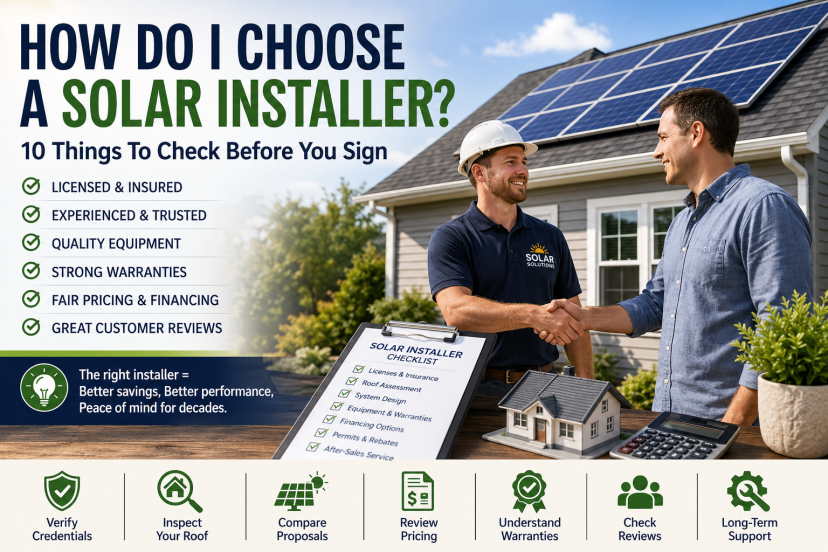
How do I choose a solar installer? Start by comparing at least three qualified solar companies. Check applicable state and local licenses, insurance, experience, customer history, equipment brands, workmanship warranties, roof assessment procedures, financing terms, and estimated system production. A trustworthy installer should provide a detailed written proposal explaining system size, equipment, estimated production, total price, warranties, permits, and installation responsibilities without pressuring you into signing immediately.
Don’t Choose Based On Price Alone
Going solar can reduce your dependence on utility electricity and potentially save thousands of dollars over the life of your system—but the company you hire can make a major difference. If you’re wondering, “How do I choose a solar installer?”, don’t simply pick the contractor offering the lowest price or biggest promised savings.
A residential solar installation combines roofing, electrical work, structural considerations, permits, utility requirements, and expensive equipment designed to remain on your home for decades. Poor installation can lead to roof leaks, disappointing energy production, warranty problems, and unexpected repair costs.
Fortunately, finding a reliable solar company doesn’t have to be complicated. By comparing several installers and asking the right questions about licensing, equipment, roof condition, warranties, financing, and projected solar production, you can make a much more confident decision and build a smarter, more energy-efficient home.
Key Takeaways
Most likely cause: Homeowners struggle to compare solar installers because proposals can use different equipment, system sizes, warranties, financing terms, and production estimates.
Usually serious? Potentially. Choosing the wrong contractor could result in poor system performance, roof problems, unexpected costs, or difficulty getting warranty service later.
First thing to check: Verify applicable contractor licenses, insurance, experience, and whether the company will perform a proper roof and electrical assessment before installation.
Best solution: If you’re asking how do I choose a solar installer?, get at least three detailed proposals and compare total cost, equipment quality, projected production, warranties, financing, roof work, and long-term service—not just the monthly payment.
🔍 1. Compare At Least Three Solar Installers
One of the easiest ways to make a better solar decision is to avoid accepting the first proposal you receive.
Request quotes from at least three qualified installers.
Multiple quotes help you understand what a reasonable system size, equipment package, and price look like for your property. They can also reveal major differences in estimated electricity production.
For example, one contractor might recommend an 8-kW system while another proposes 11 kW. That doesn’t automatically mean one is wrong, but you should ask why the recommendations differ.
Compare:
- Total System Price
- System Size In Kilowatts
- Estimated Annual Electricity Production
- Panel And Inverter Models
- Roof Work Required
- Workmanship Warranty
- Equipment Warranties
- Financing Costs
- Battery Storage Costs
- Estimated Installation Timeline
Don’t compare only the monthly loan payment. Two systems with similar monthly payments can have very different total costs.
🪪 2. Check Licensing, Insurance And Qualifications
When homeowners ask, “How do I choose a solar installer?”, contractor qualifications should be near the top of the checklist.
Solar licensing requirements vary by state and sometimes by locality. Depending on where you live, installation may require electrical, general contractor, roofing, or specialized solar licenses.
Ask for applicable license numbers and verify them through the relevant state or local licensing authority.
Also ask about insurance.
A professional contractor should carry appropriate business insurance, including liability coverage and workers’ compensation where required.
Industry credentials can provide additional information about an installer’s training and expertise. For example, certifications from organizations such as the North American Board of Certified Energy Practitioners (NABCEP) can be useful indicators of professional knowledge.
Certification, however, should be considered alongside licensing, experience, insurance, and customer service—not as the only deciding factor.
🏠 3. Make Sure The Installer Evaluates Your Roof
Solar panels may remain on a house for decades, which makes the condition of the roof extremely important.
A reputable solar installer shouldn’t simply look at an aerial image and assume your roof is ready.
Before final installation, the roof should be evaluated for issues such as:
- Roof Age
- Missing Or Damaged Shingles
- Existing Leaks
- Flashing Problems
- Roof Deck Condition
- Structural Concerns
- Available Solar Roof Area
- Shading
- Roof Orientation And Pitch
If your asphalt shingle roof is already near the end of its expected service life, replacing it before installing solar may make financial sense.
Otherwise, you could eventually have to pay to remove and reinstall the solar panels just to replace the roof.
Ask Who Is Responsible For Roof Damage
This is especially important.
Ask the installer what happens if roof penetrations leak after installation. Find out whether roof-related installation problems are covered under the workmanship warranty and how long that protection lasts.
Get the answer in writing.
⚡ 4. Compare Solar Panels And Inverters
Not every solar proposal includes the same technology.
Solar panels differ in efficiency, power output, degradation characteristics, warranty terms, dimensions, and price.
The inverter is equally important because it converts the electricity produced by your panels into electricity your home can use.
Common residential configurations include:
| System Type | Potential Advantage | Consideration |
|---|---|---|
| String Inverter | Simple, potentially lower cost | Shading can require additional optimization |
| Microinverters | Panel-level operation and monitoring | Can cost more |
| Power Optimizers | Panel-level optimization with central inverter | More rooftop electronics |
| Battery-Compatible System | Easier storage integration | Higher upfront cost may apply |
Rather than asking which technology is universally “best,” ask which system best fits your roof, shading, budget, electrical needs, and future plans.
A trustworthy installer should be able to explain why specific equipment is being recommended.
💵 5. Compare Price Per Watt—But Don’t Stop There
Solar proposals can be difficult to compare because different contractors recommend different system sizes.
One useful measurement is price per watt.
For example:
$24,000 system ÷ 8,000 watts = $3.00 per watt
This provides a basic way to compare similarly configured systems before applicable incentives.

However, price per watt isn’t everything.
A more expensive proposal could include premium panels, upgraded electrical equipment, a stronger workmanship warranty, additional roof work, or better long-term support.
When deciding how do I choose a solar installer, compare both price and value.
The cheapest system isn’t necessarily the system with the lowest lifetime cost.
📊 6. Examine The Solar Production Estimate
A solar proposal should explain how much electricity the system is expected to generate.
Be cautious of companies making extremely aggressive savings promises without explaining their assumptions.
Production depends on:
- Roof direction.
- Roof pitch.
- Local climate.
- Shading.
- Panel efficiency.
- System size.
- Equipment performance.
- Local solar resource.
- System losses.
Ask the installer what assumptions were used to calculate expected annual production.
You can also compare the proposal with independent solar estimation tools, such as the National Renewable Energy Laboratory’s PVWatts Calculator.
If one contractor predicts dramatically more production than competing installers using a similar system size, ask for an explanation.

🛡️ 7. Understand Every Solar Warranty
Solar systems can come with several different warranties, and homeowners sometimes mistakenly treat them as one warranty.
They aren’t.
Solar Warranties To Compare
Product Warranty: Covers certain manufacturing or equipment defects according to the manufacturer’s terms.
Performance Warranty: Typically guarantees that panels will retain a specified percentage of their original output capability over a stated period.
Inverter Warranty: Covers the inverter according to the manufacturer’s specific warranty.
Workmanship Warranty: Provided by the installer and may cover certain installation-related problems.
Roof Penetration Warranty: Some installers provide specific protection for leaks associated with solar mounting penetrations.
Read the actual warranty documents rather than relying only on a salesperson’s explanation.
Also ask an important question:
Who handles warranty service if something fails?
Long warranty periods are much less valuable if getting service is difficult.
💳 8. Look Beyond The Solar Loan Payment
Financing is another major factor when figuring out how do I choose a solar installer?
A salesperson may focus heavily on making your solar payment appear lower than your current electricity bill.
That comparison can be useful, but it doesn’t tell you the full cost.
Ask for:
- Cash purchase price.
- Financed price.
- Interest rate.
- Loan term.
- Fees or dealer costs reflected in the transaction.
- Total payments over the loan.
- Early repayment terms.
- Ownership details.
A low monthly payment spread over a long loan term can still result in a high total cost.
Compare the cash price with the financed terms before deciding.
💰 9. Verify Solar Incentives Instead Of Relying On Sales Claims
Federal and local incentives can significantly affect the economics of residential solar, but incentive programs and eligibility rules can change.
Depending on current law and your individual circumstances, homeowners may have access to federal clean-energy tax incentives as well as state, local, or utility programs.
Potential programs can include:
- Federal tax incentives.
- State tax credits.
- Utility rebates.
- Battery incentives.
- Property tax exemptions.
- Sales tax exemptions.
- Local financing programs.
Don’t automatically treat a tax credit as an instant cash rebate.
Tax benefits depend on applicable tax rules and your circumstances. Verify current federal requirements and consult a qualified tax professional when necessary.
Also check your state energy office and electric utility for current programs.
🔋 10. Think About Your Future Energy Needs
A good solar installer should ask more than, “What was your electricity bill last month?”
Your electricity consumption may change significantly during the next several years.
Tell potential installers if you’re considering:
- An electric vehicle.
- Heat pump HVAC.
- Heat pump water heating.
- Home additions.
- A swimming pool.
- Battery storage.
- An accessory dwelling unit.
- Major efficiency improvements.
Future electricity needs can influence system design.
At the same time, simply installing the largest possible system isn’t necessarily best. Utility rules, available roof space, local interconnection requirements, compensation for exported electricity, and your budget should all be considered.
🚩 Warning Signs When Choosing A Solar Installer
Good contractors educate homeowners rather than pressure them.
Be cautious if a salesperson:
- Claims solar is completely “free.”
- Refuses to provide a detailed written proposal.
- Won’t identify exact panel or inverter models.
- Avoids questions about contractor licensing.
- Makes unrealistic electricity savings guarantees.
- Pressures you to sign immediately.
- Focuses only on monthly payments.
- Doesn’t discuss your roof condition.
- Can’t clearly explain warranties.
- Makes tax promises specific to your personal situation without appropriate qualifications.
Solar is a major home improvement project. You should have enough time to understand the contract before signing.
🌱 How A Good Installer Can Improve Long-Term Solar Savings
Installation quality matters because solar savings are generated over many years.
The right system needs to produce electricity reliably while protecting the roof underneath it.
A qualified installer can help optimize panel placement, reduce avoidable shading, properly weatherproof roof penetrations, select compatible electrical equipment, obtain necessary permits, and complete utility interconnection requirements.
Even small differences in system design and reliability can become meaningful over decades.
That’s why choosing a solar company based solely on the lowest upfront price can be shortsighted.
Think about lifetime value, not just installation cost.
👷 When To Call A Professional
Contact a qualified roofing contractor before installing solar if your roof is leaking, sagging, visibly damaged, approaching replacement age, or has a history of moisture problems.
A qualified solar professional should evaluate your electricity use, roof characteristics, shading, electrical system, equipment options, and local permitting requirements before finalizing the installation.
If significant electrical upgrades or structural modifications are required, properly licensed professionals should handle those portions of the project.
❓ Frequently Asked Questions
1. How Do I Know If A Solar Installer Is Reputable?
Check applicable state and local licenses, insurance, years in business, customer reviews, complaint history, equipment offered, workmanship warranty, and service procedures. Obtain several written proposals and verify important claims independently.
2. How Many Solar Quotes Should I Get?
Getting at least three solar quotes is a useful starting point. Comparing several proposals helps you evaluate system size, price, equipment, warranties, financing, and projected energy production.
3. What Questions Should I Ask A Solar Installer?
Ask about licenses, insurance, system size, projected production, panel and inverter models, warranties, roof penetrations, permits, utility interconnection, financing, maintenance, monitoring, and who provides service after installation.
4. Should I Choose The Cheapest Solar Installer?
Not automatically. A low price may be attractive, but equipment quality, system design, workmanship, warranty coverage, roofing practices, and long-term service can be equally important.
5. Should I Replace My Roof Before Installing Solar?
Consider roof replacement first if the roof is near the end of its expected life or has significant damage. Replacing it later could require removing and reinstalling the solar array, creating additional expense.
6. Is NABCEP Certification Important For A Solar Installer?
NABCEP credentials can demonstrate additional solar-industry training and knowledge, but they shouldn’t replace checks for required licensing, insurance, experience, workmanship quality, references, and strong contract terms.
7. How Can I Compare Two Solar Quotes?
Compare system size, total cash price, price per watt, expected annual production, exact equipment, warranties, financing terms, roof work, monitoring, estimated timeline, and post-installation service. Make sure you’re comparing similar systems before choosing based on price.
🌞 Final Thoughts: Choose The Installer, Not Just The Solar Panels
If you’re still wondering “How do I choose a solar installer?”, remember one simple rule: don’t choose based on price alone.
Solar panels may spend decades on your roof. The contractor designing and installing the system can be just as important as the equipment itself.
Get at least three quotes, verify licenses and insurance, inspect your roof first, compare equipment and warranties, question production estimates, understand financing, and read the contract carefully.
If your roof is older, start by requesting a professional roof inspection or roofing quote. Once you know the roof is solar-ready, compare qualified solar installers and choose the proposal offering the strongest combination of system performance, installation quality, warranty protection, service, and long-term value.
Disclaimer: This article is for general informational purposes only. Solar pricing, incentives, tax rules, utility programs, contractor licensing requirements, energy savings, and installation requirements vary by location and may change. Consult appropriately licensed solar, roofing, electrical, insurance, tax, or other professionals before making financial or home improvement decisions.
Explore more:
- Solar For Small Homes: Is It Really Worth It
- How Many Solar Panels Do I Need For My House?
- What Happens If A Solar Panel Breaks?