What Is The Best Solar Inverter For Small Home? 7 Smart Options To Consider
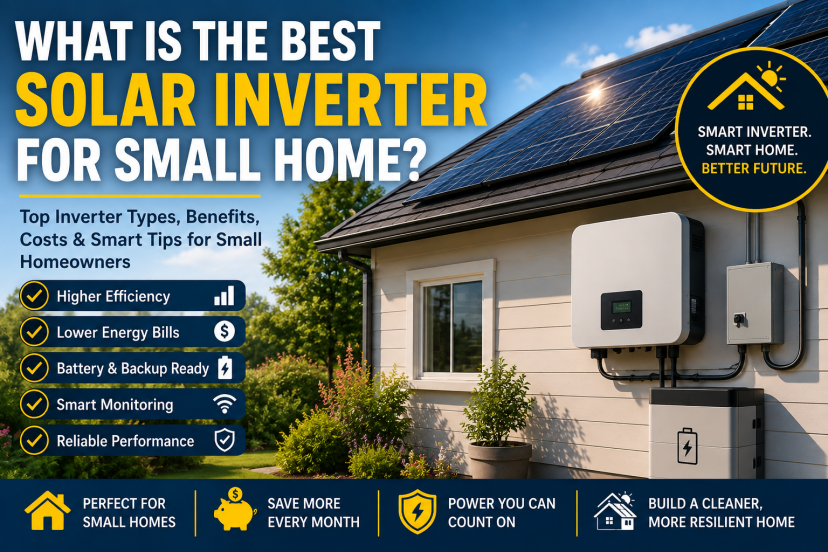
Installing solar panels on a smaller home can be a smart way to lower electricity bills without paying for an oversized system. But panels are only part of the equation. If you’re wondering what is the best solar inverter for small home, choosing the right inverter can have a major impact on how efficiently, reliably, and conveniently your solar system operates.
The inverter converts the direct-current (DC) electricity produced by your solar panels into alternating-current (AC) electricity your household can use. Today’s systems may also provide panel-level monitoring, battery integration, backup capabilities, and smart energy management.
For a small U.S. home, however, bigger isn’t automatically better. The right inverter should match your solar array, roof conditions, electrical needs, future plans, and budget.
Below, we’ll compare the main inverter options and explain how to choose a system that provides reliable performance without unnecessary expense.
⚡ Quick Answer: What Is The Best Solar Inverter For Small Home?
For many small homes, a properly sized string inverter or microinverter system offers the best combination of efficiency, reliability, and value. String inverters are often economical for simple, mostly unshaded roofs, while microinverters can be especially useful on roofs with shade or panels facing different directions. Homeowners planning battery storage should also consider a hybrid or battery-compatible inverter.
Key Takeaways
Most likely cause: Homeowners often struggle with inverter selection because system size, roof shading, battery plans, electrical requirements, and inverter technologies vary considerably.
Usually serious? No, but choosing an incorrectly sized or poorly matched inverter can reduce system performance, limit future upgrades, or increase installation costs.
First thing to check: Determine your solar array size, roof orientation, shading conditions, household electricity use, and whether you may add battery storage later.
Best solution: When deciding what is the best solar inverter for a small home, compare a correctly sized string inverter, microinverters, and a hybrid inverter based on your roof and long-term energy goals.
🏠 What Does A Solar Inverter Actually Do?
Solar panels generate DC electricity when sunlight reaches their photovoltaic cells. Most household appliances and the U.S. electrical grid operate on AC electricity.
The solar inverter performs the critical job of converting DC power into usable AC power.
Modern inverters can do much more. Depending on the system, an inverter may:
- Convert Solar Electricity: Changes DC electricity into household-compatible AC electricity.
- Optimize Energy Production: Uses maximum power point tracking to help the array operate efficiently.
- Monitor Performance: Tracks solar production and identifies possible problems.
- Communicate With The Grid: Helps the system meet utility interconnection requirements.
- Integrate Batteries: Certain models manage solar battery charging and discharging.
- Support Backup Power: Compatible equipment may help provide electricity during outages when paired with batteries and appropriate transfer/islanding equipment.
Because the inverter performs such an important role, it should never be chosen simply by looking for the cheapest unit available.
☀️ What Is The Best Solar Inverter For Small Home Systems?
There isn’t one inverter that is best for every small house. Three major technologies dominate residential solar installations.
1. String Inverters
A string inverter connects multiple solar panels together in one or more electrical strings. The DC electricity travels from the panels to a central inverter, which converts it to AC electricity.
This is one of the simplest and most established solar inverter designs.
Best for: Small homes with straightforward roofs and limited shade.
Advantages include:
- Lower Equipment Costs In Many Installations
- Simple System Architecture
- Centralized Maintenance
- Proven Technology
- Good Efficiency
The main disadvantage is that panel-level differences can affect string performance, although modern designs and power optimizers can reduce some of these limitations.
For a small roof with panels facing the same direction and receiving consistent sunlight, a string inverter can offer excellent value.
2. Microinverters
Microinverters operate differently. Instead of using one central inverter, a small inverter is installed beneath or near each solar panel.
Each panel converts its own DC electricity into AC electricity.

This can be particularly useful when the roof experiences partial shade or has panels facing multiple directions.
Microinverters provide several advantages:
- Panel-Level Power Conversion
- Individual Panel Monitoring
- Excellent Performance On Complex Roofs
- Easy System Expansion
- No High-Voltage DC String Running To A Central Inverter
They can cost more upfront because multiple devices are required.
However, for a small home with a relatively small number of panels, the additional expense may be manageable.
3. Hybrid Inverters
A hybrid solar inverter combines solar power conversion with functionality designed for energy storage.
This can be attractive if you want to install a home battery now or expect to add one later.
Depending on the equipment and system design, a hybrid inverter may manage:
- Solar Panel Production
- Battery Charging
- Battery Discharging
- Grid Electricity
- Household Loads
- Backup Power
If energy resilience is one of your goals, a battery-ready or hybrid inverter deserves serious consideration.
Remember that simply having a hybrid inverter does not automatically keep your lights on during an outage. Backup operation requires compatible batteries, controls, and properly installed isolation equipment.
📊 Solar Inverter Comparison For Small Homes
| Inverter Type | Best For | Shade Performance | Battery Ready | Typical Cost Level | Expansion |
|---|---|---|---|---|---|
| String Inverter | Simple Sunny Roofs | Fair–Good | Model Dependent | $ | Moderate |
| String + Optimizers | Mixed Roof Conditions | Very Good | Model Dependent | $$ | Good |
| Microinverters | Shade/Complex Roofs | Excellent | System Dependent | $$$ | Excellent |
| Hybrid Inverter | Solar + Battery | Good | Yes | $$$ | Very Good |
Actual performance and pricing vary by manufacturer, system design, installer, and location.
🔋 How To Size A Solar Inverter For A Small Home
One of the biggest mistakes homeowners make is assuming inverter capacity should automatically equal the total nameplate wattage of their solar panels.
Solar system design is more complicated.
For example, a home might have a 5-kilowatt solar array but use an inverter with a somewhat lower AC rating. This relationship is often called the DC-to-AC ratio or inverter loading ratio.
Why would installers do this?
Solar panels rarely operate at their laboratory-rated maximum output throughout the day. Production changes with temperature, sunlight intensity, panel orientation, season, and other factors.
A slightly larger DC array relative to inverter AC capacity can sometimes increase inverter utilization and overall economics, although excess instantaneous DC power may occasionally result in “clipping.”
Correct sizing depends on:
- Solar Array Capacity
- Panel Orientation
- Local Climate
- Shading
- Inverter Specifications
- Utility Requirements
- Electrical Service
- Future Expansion Plans
A qualified solar designer should calculate the appropriate inverter size rather than relying on a simple rule of thumb.
🌳 Which Solar Inverter Is Best For A Shaded Roof?
Microinverters or systems using panel-level power electronics are often attractive when shade affects only certain panels.
Imagine that a chimney shades one panel during the morning while a nearby tree shades another in the afternoon. A conventional string arrangement may be less flexible when individual panels experience different conditions.
Microinverters allow panels to operate more independently.
Power optimizers provide another option. An optimizer is installed at each panel and works with a central inverter to manage panel-level performance.
Before spending more on equipment, however, determine how severe the shading actually is.
Professional solar design software can estimate annual shading losses. In some cases, trimming a tree or changing panel placement may provide a simpler solution.
🧭 What About Roof Orientation?
Small homes sometimes have limited usable roof area.
You may need panels on several roof sections—for example, some facing south and others facing east or west.
This doesn’t necessarily prevent a productive solar installation.
Modern string inverters may have multiple maximum power point trackers (MPPTs), allowing separate groups of panels to operate under different conditions. Microinverters also handle different orientations particularly well because each panel operates independently.

Your installer should evaluate:
- Roof Direction
- Roof Pitch
- Shading
- Available Surface Area
- Chimneys And Vents
- Panel Layout
- Local Fire-Access Requirements
The best solar inverter for a small home should match the actual roof rather than forcing the roof layout to match the inverter.
🔌 Should You Choose A Battery-Ready Inverter?
If you think you may want a battery in the future, discuss this before installing solar.
Retrofitting energy storage later is certainly possible, but planning ahead can sometimes simplify the project.
A battery can store excess solar electricity for later use and, when installed with compatible backup equipment, provide power to selected loads during utility outages.
This is especially appealing for homeowners concerned about:
- Power Outages
- Grid Reliability
- Time-Of-Use Electricity Rates
- Emergency Preparedness
- Greater Energy Independence
Before choosing a hybrid inverter, verify which batteries are compatible. Some systems operate within specific manufacturer ecosystems, potentially limiting future choices.
💰 How Much Does A Solar Inverter Cost?
Solar inverter pricing varies widely.
Instead of focusing only on the equipment price, consider the inverter as part of the entire installed solar system.
Costs can be affected by:
- System Capacity
- Inverter Technology
- Number Of Panels
- Electrical Upgrades
- Monitoring Equipment
- Roof Complexity
- Battery Compatibility
- Local Labor Rates
- Permit And Interconnection Requirements
A conventional string inverter may have a lower initial equipment cost than microinverters. However, installation design, warranties, future replacement costs, and energy production should also be considered.
Ask installers for an itemized proposal whenever possible.

📈 Inverter Efficiency And Long-Term Savings
Solar inverter efficiency measures how effectively the inverter converts DC electricity into AC electricity.
Modern residential inverters commonly achieve very high conversion efficiencies, so small percentage differences between reputable models may not translate into dramatic household savings.
Instead of choosing an inverter based solely on the highest advertised efficiency percentage, consider the entire package:
Efficiency + Reliability + Warranty + Monitoring + Compatibility + Installer Support
For example, an inverter with excellent specifications provides little value if replacement parts or warranty service are difficult to obtain.
Long-term support can be especially important because solar panels are often designed to operate for decades.
🛡️ Solar Inverter Warranties Matter
Always compare warranty coverage before selecting an inverter.
Warranty periods vary significantly between manufacturers and products. Some warranties may also be extendable for an additional charge.
Check:
- Warranty Length
- Parts Coverage
- Labor Coverage
- Shipping Costs
- Replacement Procedures
- Installer Responsibilities
- Monitoring Requirements
- Transferability To A Future Homeowner
Microinverters may have different warranty structures from central string inverters, so don’t compare only the number of warranty years.
Read the actual terms.
🏡 Roof Compatibility And Inverter Placement
The inverter itself may not always sit on the roof. Central string and hybrid inverters are often mounted on a wall near electrical equipment, while microinverters are normally installed at the solar panels.
But your roofing system still matters.
Solar installations can be designed for:
- Asphalt Shingles
- Standing-Seam Metal Roofing
- Tile Roofing
- Flat Or Low-Slope Roofing
- Certain Composite Roofing Systems
If your roof needs replacement soon, consider completing that work before installing solar panels.
Removing a solar array several years later to replace an old roof creates additional labor and expense.
This is one reason coordinating your roofing and solar projects can provide significant long-term value.
💵 Federal Solar Tax Credit And Other Incentives
Eligible U.S. homeowners may be able to use federal incentives for qualifying residential solar installations under current tax law.
State governments, utilities, and municipalities may also offer rebates, tax incentives, net-metering arrangements, battery programs, or other renewable-energy benefits.
Rules can vary considerably by location and change over time.
Importantly, installing solar does not automatically make an entire roof replacement eligible for a solar tax credit. Homeowners should confirm current eligibility requirements through official government sources or a qualified tax professional.
Also check state and utility programs before choosing your equipment because some incentives may have specific technical or installation requirements.
🔧 Solar Inverter Installation And Maintenance Tips
Solar inverters generally require relatively little homeowner maintenance, but proper installation matters.
For a central inverter:
- Keep The Area Around It Clear
- Follow Manufacturer Ventilation Requirements
- Avoid Blocking Cooling Vents
- Check Monitoring Alerts
- Watch For Unusual Error Messages
- Follow Recommended Inspection Schedules
For microinverters, routine homeowner access is usually unnecessary because the units are installed beneath the panels.
Monitoring software can be extremely useful. If solar production suddenly drops, monitoring data can help identify whether the problem involves one panel, the inverter, shading, or the entire system.
Never open or repair solar electrical equipment yourself unless you are properly qualified.
👷 When To Call A Professional
Contact a qualified solar installer or licensed electrician when designing, installing, replacing, or troubleshooting an inverter.
Professional help is particularly important if you notice repeated inverter faults, unexpected production losses, overheating, electrical odors, damaged wiring, or shutdowns.
You should also consult a roofing professional if your roof is leaking, damaged, or approaching replacement age before installing solar.
Ideally, your roofer and solar installer should coordinate the project so the mounting system, flashing, roof warranty, and expected roof lifespan work together.
❓ Frequently Asked Questions
What Size Inverter Do I Need For A Small House?
The correct size depends on the solar array rather than simply the square footage of your house. Panel capacity, orientation, climate, shading, and inverter specifications should all be considered.
Is A 5kW Inverter Enough For A Small Home?
A 5kW inverter may be appropriate for many residential solar arrays, but household size alone doesn’t determine inverter capacity. Your solar installer should size the inverter according to the array and electrical design.
Are Microinverters Better For Small Solar Systems?
Microinverters can be an excellent choice for small systems, especially when panels experience different shading or orientations. They also provide individual panel monitoring and can make future expansion easier.
Is A String Inverter Cheaper Than Microinverters?
String inverters often have lower upfront equipment costs because one central inverter handles multiple panels. However, overall installed costs and lifetime value vary by project.
Can I Add A Battery To My Solar Inverter Later?
Sometimes. Battery compatibility depends on the inverter and system architecture. If you expect to add storage later, discuss battery-ready or compatible options before installing solar.
How Long Does A Solar Inverter Last?
Lifespan varies by inverter type, manufacturer, operating environment, and maintenance. Central inverters may require replacement during the lifespan of the solar panels, while some microinverter products carry longer warranties. Always compare manufacturer specifications and warranty terms.
Does A Solar Inverter Work During A Power Outage?
A standard grid-connected solar system normally shuts down during a grid outage for safety. Backup electricity generally requires a properly designed system with compatible battery storage, controls, and isolation equipment.
🌱 Conclusion: Choosing The Best Solar Inverter For A Small Home
So, what is the best solar inverter for small home?
For a simple, sunny roof, a quality string inverter can offer excellent performance at a reasonable cost. For roofs with shade, multiple orientations, or plans for gradual expansion, microinverters may provide greater flexibility. If battery storage and backup power are priorities, a hybrid or battery-compatible system may make more sense.
Don’t focus only on inverter wattage or price.
Compare efficiency, warranty coverage, monitoring capabilities, battery compatibility, installer support, roof conditions, and expected long-term performance.
Before signing a solar contract, request quotes from qualified installers and ask them to explain why their proposed inverter is appropriate for your particular roof and solar array. If your roof is aging, get a roofing assessment at the same time. Coordinating both projects can help you avoid future removal costs and build a smarter, more resilient home energy system.
Disclaimer: Solar equipment costs, electricity savings, tax credits, rebates, utility programs, and installation requirements vary by location and can change over time. Always verify current incentives and consult qualified solar, electrical, roofing, and tax professionals before making installation or financial decisions.
 Explore more:
- DIY Solar Maintenance: Simple Ways
- What Is The Best Cheap Solar Setup For Small House?
- Small Home Generators Vs Solar: Which Backup